By Kazuki Saito, Virender Kumar, Jerico Bigornia, and Iris Bugayong
Through DSRC and a MAFF-supported project, researchers and partners are evaluating Japan’s iron-coating technology for improved crop establishment as well as reducing methane emissions.
Across Asia, rice farmers face mounting challenges: labor shortages, rising input costs, persistent weed pressure, stagnant water in poorly drained fields, early flooding during crop establishment due to unpredictable heavy monsoon rainfall, and the urgent need to reduce greenhouse gas (GHG) emissions from flooded systems. Conventional rice transplanting requires substantial labor input. On the other hand, wet direct seeding, although more time-efficient, frequently results in irregular crop stands and suboptimal establishment, especially under conditions of sudden flooding during the crop establishment phase or uneven field leveling. In wet-direct seeded rice (DSR), seeds that are sown on the surface of puddled fields are prone to drift if heavy rainfall occurs soon after planting. They are also more susceptible to biotic stresses such as bird predation and rodent damage, which often result in uneven and poor crop establishment
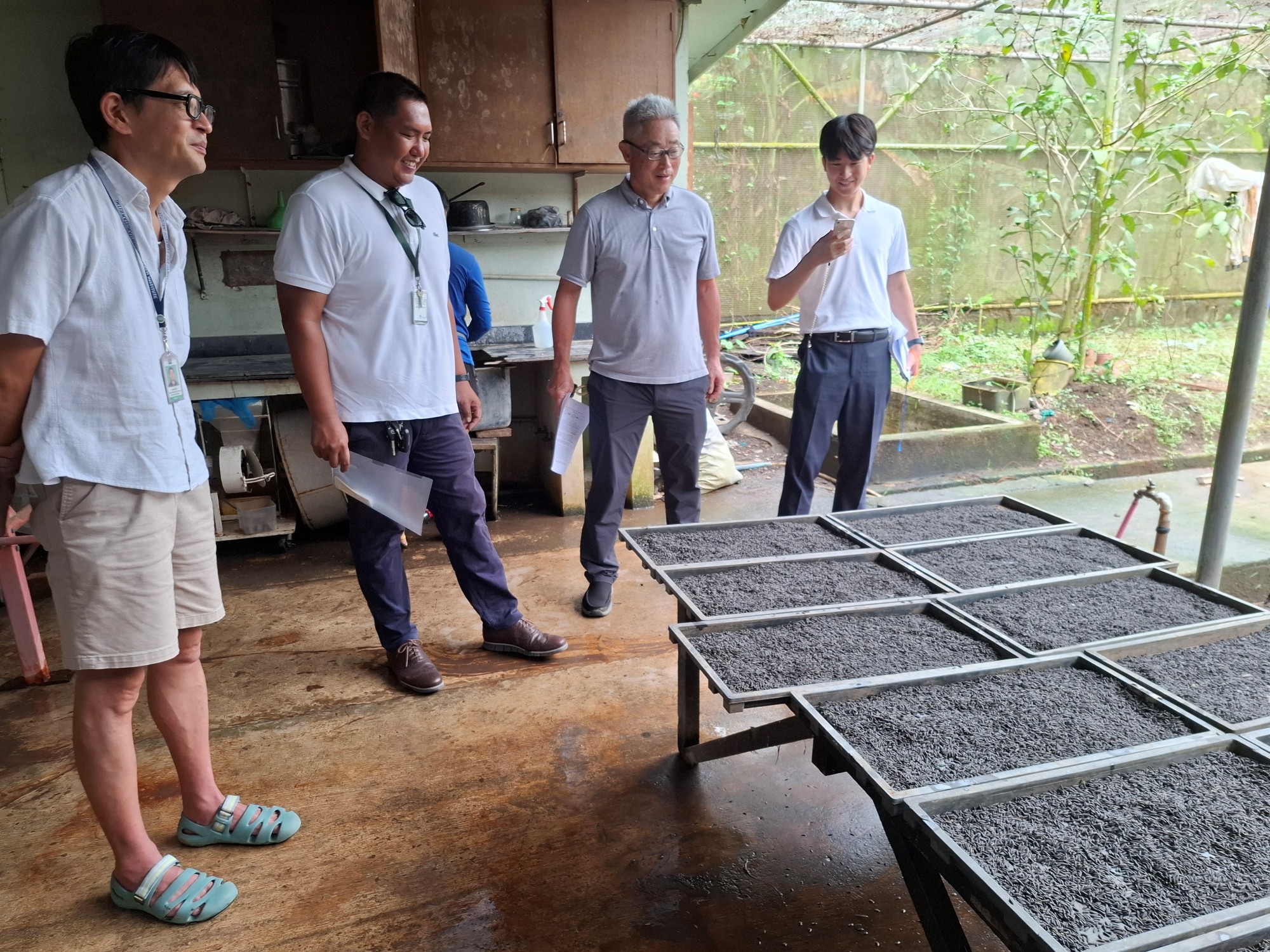
Developing technologies that improve rice crop establishment is therefore critical for enhancing productivity and climate resilience. The iron-coated seed technology being tested at the International Rice Research Institute (IRRI) offers a promising solution by improving seed placement and early protection. The added coating weight reduces seed drift, strengthens seed-soil contact, and helps protect against birds and rodents. Because the coating delays germination, coated seeds can withstand shallow flooding from unexpected rainfall, allowing a modified water-seeding approach where water recedes naturally. This reduces the need for forced drainage in wet-DSR, which can result in the loss of water, nutrients, and soil minerals. The technology uses KONABIJINTM, developed by JFE Steel Corporation, whose products are also distributed globally through companies such as Metal One Corporation.
Originally developed in Japan, KONABIJINTM combines reduced iron powder and calcined gypsum. This allows farmers or drones to broadcast coated seeds directly onto shallowly flood.ed fields without the need for draining, as the iron coating of the seed can tolerate its first couple of days of flooding. This achieves more uniform crop stands while reducing the need for replanting needs and early weed competition.
“Once the coated seed hits the water, it sinks and stays,” explained Jerico Bigornia, IRRI Associate Scientist in Weed Science. “The coating helps the seedlings establish evenly, even under shallow flooding or waterlogged conditions.”
The ongoing work is being carried out under the Direct-Seeded Rice Consortium (DSRC), a global public-private partnership advancing direct-seeding technologies for sustainable rice production. JFE Steel Corporation is also a member of DSRC. Within DSRC, researchers are testing improved seed-treatment options such as iron coating to make water seeding more precise and reliable. Early results show that the coating enhances crop establishment under wet-DSR and modified water seeding.
This research is also one of activities under the five-year project “Development of Rice Cropping Systems Toward Carbon Neutrality and Food Security in ASEAN Countries,” funded by Japan’s Ministry of Agriculture, Forestry and Fisheries (MAFF). Running until 2029, the project brings together researchers, governments, and the private sector to evaluate and adapt promising technologies like Japan’s iron-coating innovation under tropical field conditions. Beyond technology testing, this MAFF-supported project contributes to GHG measurement and analysis, examining how improved agronomic practices can support food security and mitigation goals.
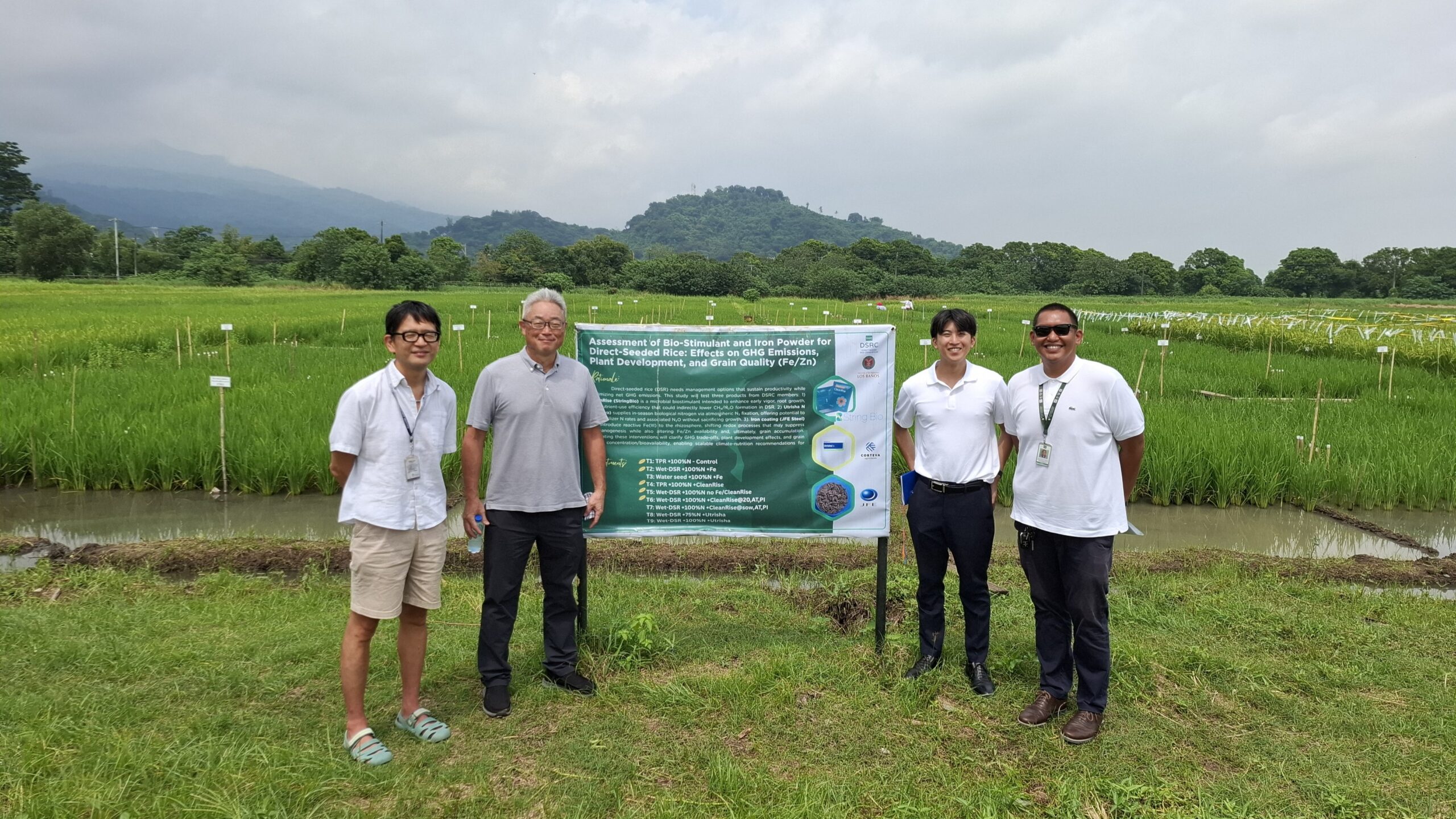
As part of the knowledge exchange and exploration of potential areas of application, Metal One staff visited IRRI to observe the iron-coating process and understand how researchers apply and handle the coated seed. Future engagements may include sharing technical information with local partners and technicians who will conduct on-farm demonstrations through DSRC and MAFF project activities.
“Our motivation is to add value to people and communities,” said Taku Umezaki, General Manager of Metal One Manila Branch. “If we can help lower emissions and increase harvests, everyone benefits.”
For IRRI, such interactions reflect its 2025–2030 Strategy, which places partnership, capacity strengthening, and scaling at the center of agricultural impact. “Innovation alone does not create impact,” said Dr. Kazuki Saito, IRRI Senior Scientist II for Cropping Systems Agronomy and Climate Change, and leader of the MAFF project. “Real change happens when research is matched with the right partners, those who can bring these technologies to the farmers and communities that need them most.”