
The driving policy and guiding principles of the Swiss Agency for Development and Cooperation (SDC) aim to help partner countries overcome endemic poverty and to achieve food security and environmental sustainability. To manage this support efficiently, SDC promotes growth among the most disadvantaged groups in society by helping them improve production, manage environmental problems and provide better access to education and basic health care. We recognize that the focus of development today is on achieving community-level impact through better-harmonized programs and procedures, and actively assessing impacts against the aims of the United Nations Millennium Development Goals and World Bank Poverty Reduction Strategies.
SDC’s key mandate is to improve the living conditions of the rural poor, who represent 80% of the world’s 850 million chronically or acutely malnourished people. This mission involves advancing sustainable agriculture for food security, livelihood improvement and pro-poor growth. The major challenge ahead will be to meet growing food demand with limited land resources, and without sacrificing natural habitats or causing further deforestation and loss of biodiversity.
New approaches to agriculture confront producers in an increasingly liberalized market, in which there is unequal access to assets and limited participation in decision-making. SDC believes research and knowledge can pave the way forward. We recognize that the agricultural sector will grow and improve its efficiency only if research delivers appropriate results along with practical and locally adapted solutions.
Within this focus, SDC supports the International Rice Research Institute (IRRI) and other Consultative Group on International Agricultural Research (CGIAR) centers, and has been an active member of the group since its inception. The CGIAR’s research is one important link in a chain of knowledge generation for development. SDC’s support for agricultural research goes hand-in-hand with building capacity in human resources and strengthening institutions. This support is based not only on the research focus, but also on whether appropriate partnership arrangements and implementation mechanisms exist. And while we do not try to turn research institutions into development agents, we believe the targets of research — the poor and disadvantaged — must always remain in sight. Research for development is about exchanging knowledge and building ownership, and this requires focused, proficient partner institutions that are dedicated to improving life for the poor.
SDC’s support for the CGIAR system is threefold. First, unrestricted grants to core center-specific programs and the CGIAR Challenge Programs have remained steady over the past few years at US$10 million per year. Second, projects based in specific target countries receive a similar amount. Third, to maintain a critical mass of expertise in agricultural research for development, SDC helps build networks between Swiss research centers and those of the CGIAR, and provides resources for the Junior Professional Offi cer Program. In total, SDC’s commitment to the CGIAR approaches $20 million annually, making SDC the group’s 8th-largest donor.
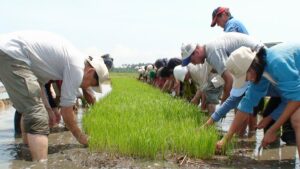
IRRI is an important partner of SDC, particularly in Asia. The LaoIRRI Rice Research and Training Project and the Asia-wide Irrigated Rice Research Consortium (IRRC) are two typical examples of successful partnerships with a concrete impact on food security and livelihoods. Tools developed by the IRRC, for example, are gaining tremendous popularity among Asian rice farmers. In Vietnam, the impact of the Ba Giam, Ba Tang (“Three Reductions, Three Gains”) campaign is expected to reach and improve the livelihood of more than 12 million rice farmers by decreasing their dependence on insecticides. This, in turn, increases farmers’ incomes while reducing unnecessary health hazards and environmental pollution.
Getting technologies into farmers’ fields requires researchers to work closely with farmers and involve them in all steps of research, from analyzing their problems through to finding new technologies. The measure of researchers’ success should be the adoption rate of appropriate technologies at the farm level, rather than number of publications or scientific rigor alone. In this vein, SDC will continue its support for research that leads to tangible improvements in the lives of the poor.
_____________________________________
Dr. Katharina Jenny is a Senior Advisor in the Natural Resources and Environment Division of the Swiss Agency for Development and Cooperation