By Christian Dohrmann
Climate-smart rice starts with good intentions, but the methods have to survive real fields, real weather, and real mud. This story follows the International Rice Research Institute (IRRI) and its long-standing partner Kasetsart University through one growing season as careful experimental plans meet muddy reality, and small practical fixes add up to stronger evidence for lower-emission rice in Thailand.
Thailand’s rice fields are more than a source of food and income. Under the Green Climate Fund–supported project Thai Rice: Advancing Climate-Smart Technologies to Strengthen Rice Farming in Thailand (Thai Rice GCF), the International Rice Research Institute with our local partners have turned the fields into open-air laboratories. While the ambitions of measuring how rice is grown, how much greenhouse gas is emitted, and testing the means to bring those emissions down sound simple in theory, the practical execution is hard to do well.
From workshop tables to field layouts
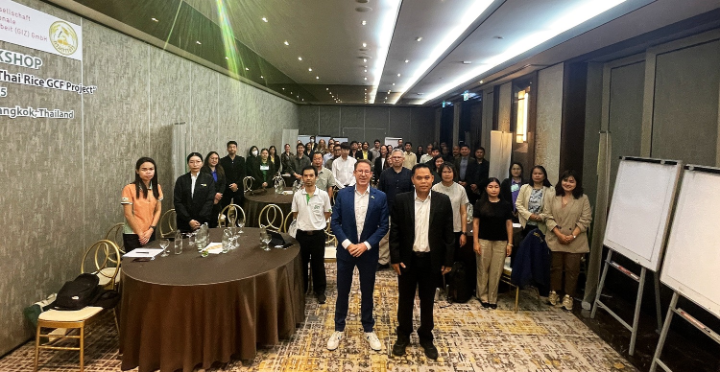
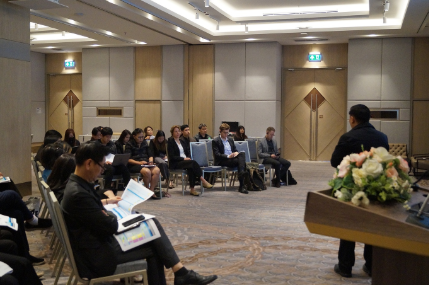
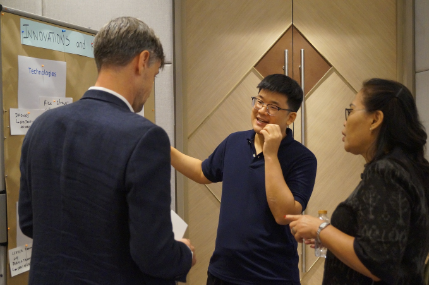
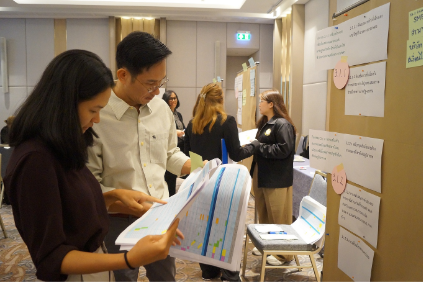
It all started with another day in a meeting room. In February, experts from the Rice Department of Thailand, Kasetsart University, Deutsche Gesellschaft für Internationale Zusammenarbeit (GIZ GmbH), and IRRI came together for a planning workshop to turn ambitions into a concrete work plan. On paper, it all looked neat and orderly, and we were anticipating the target season to arrive. Nevertheless, when those plans met real fields, farmers, and weather theory and reality do not always align.
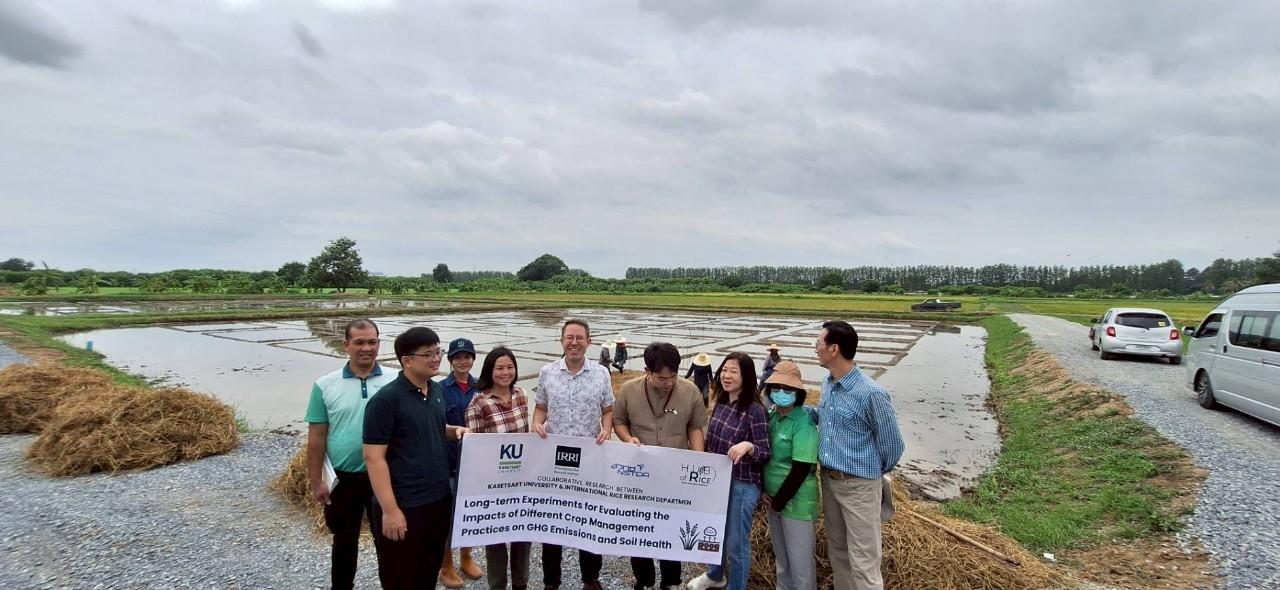
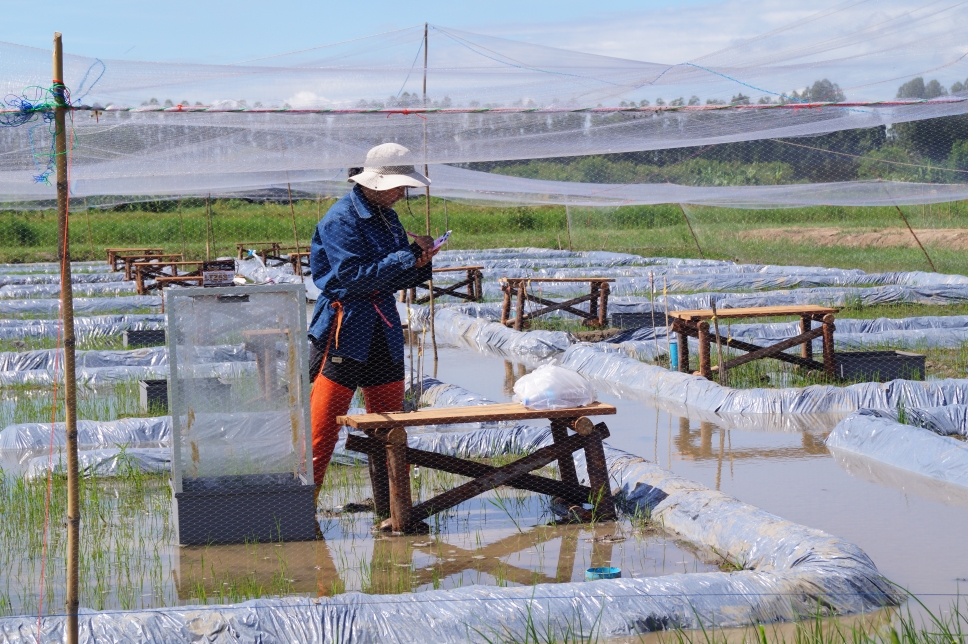
Following the meeting, by the second quarter of 2025 at the Kasetsart University (KU) Kamphaeng Saen campus, we established our main flooded-rice greenhouse gas experiment. Together with our KU colleagues, we laid out the plots, installed the gas chambers and water-control structures, and agreed on a shared sampling calendar for the season.
Shortly after, we joined the national baseline survey team in Suphan Buri to test how a new digital questionnaire worked in real villages. By that time the core team already knew the tool well. Farmers were called and queued in, and the supervisor made sure interviewers understood what each question was trying to find out, not just how it was written on the screen. Ten interviewers could finish roughly fifty farmer interviews in a morning, and each conversation took about half an hour. Testing the new tools also proved fruitful in preventing common data collection errors: built-in checks blocked unrealistic answers, such as inaccurate fertiliser amounts.
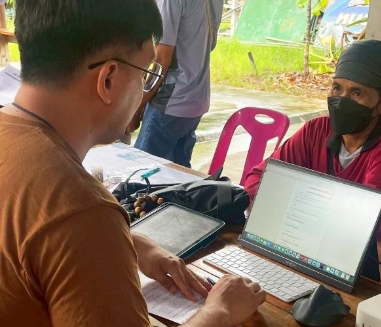
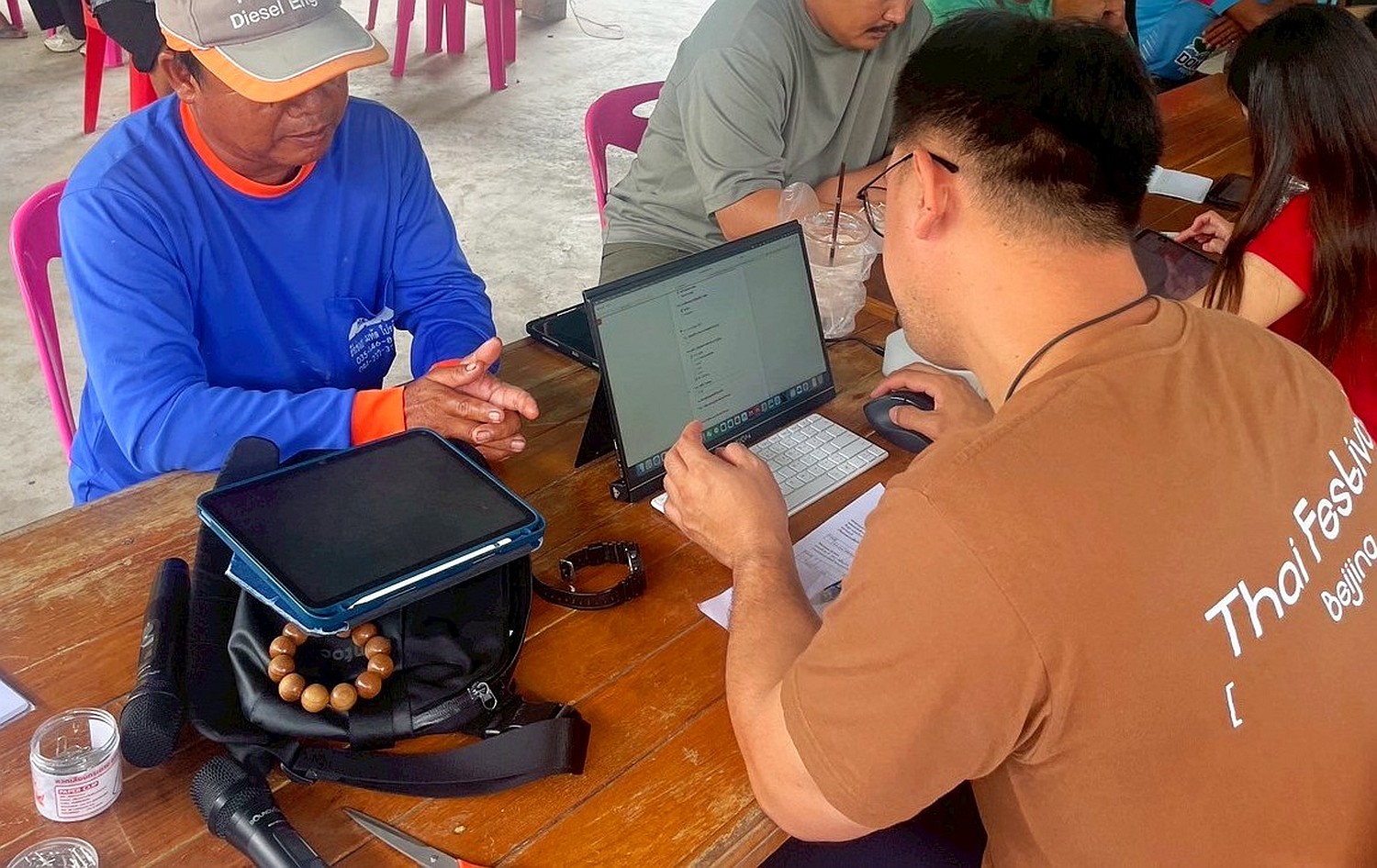
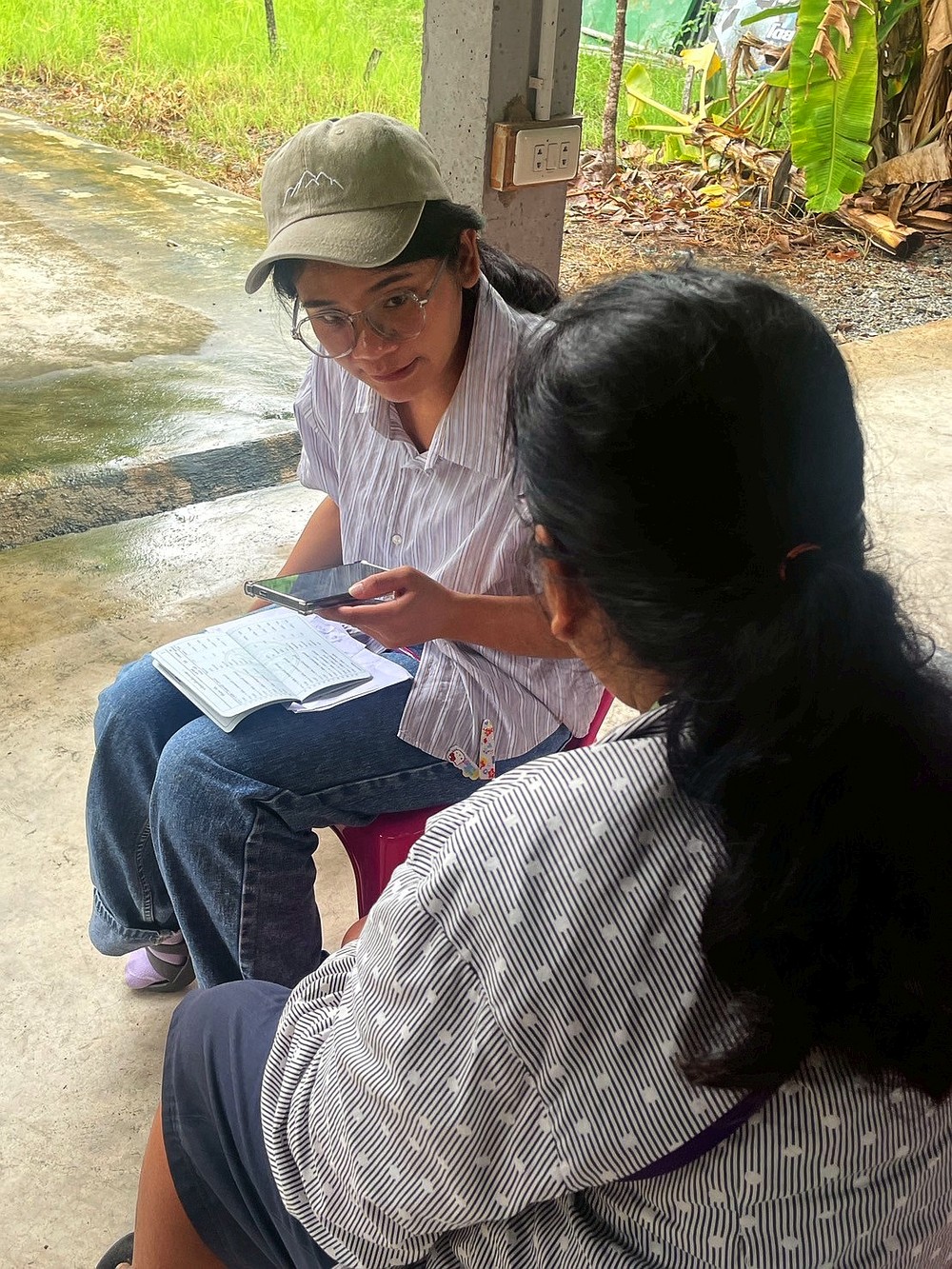
The trial led us to a few clear decisions. Field staff would record every problem they saw. The survey managers would review the most common issues, adjust the tool where needed, and keep the questionnaire light enough to use in busy seasons. The result has been a survey that is lean but rich, and grounded in how farmers actually manage their fields. From the middle of the year onward, we conducted the nationwide baseline survey covering 21 rice producing provinces of Thailand.
Also mid-year, attention shifted back to the Kamphaeng Saen campus, where the project’s main flooded-rice greenhouse gas experiment is based. We walked through the prepared plots and checked how straw and stubble had been incorporated into the soil. We discussed with KU researchers how water would be managed to allow alternate wetting and drying, and went over the plan for measuring crop growth, taking gas samples, and possibly flying drones over the field later in the season. Presentations from the researchers helped link this new work with ongoing studies on emissions, so that methods and timing matched.
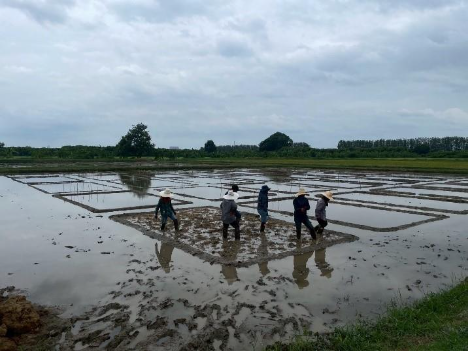
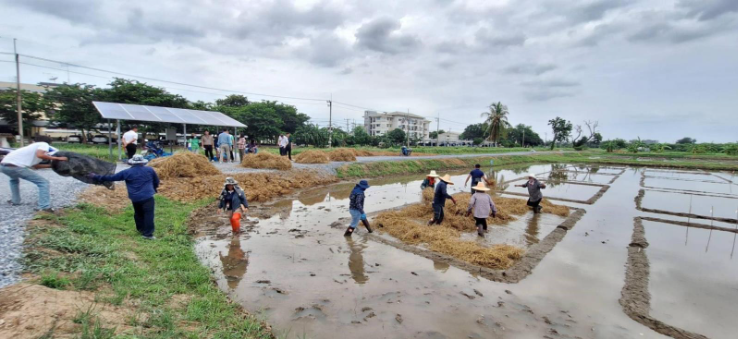
That visit effectively closed the design phase, and we departed from the campus’s fields with a shared understanding of everyone’s involvement, timing of gas measurements, and how we would each use the data.
Turning gadgets into field tools
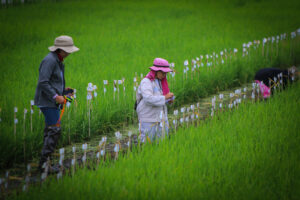
In August, we moved to KU’s Rice Science Center, where drones would be used to track water levels and crop growth. Together with the Center, we explored pilot and support roles, reviewed basic flight rules, and helped assemble floating targets, which sit on the water surface and appear in every image so that we can estimate water depth and align images over time.
Yet the setup in the field had been slower than hoped. Nets meant to protect the seed against birds had to be repaired and stretched over each plot by hand. This was labour intensive and dependent on available personnel. At last, seed sowing had to be pushed back by not quite a week.
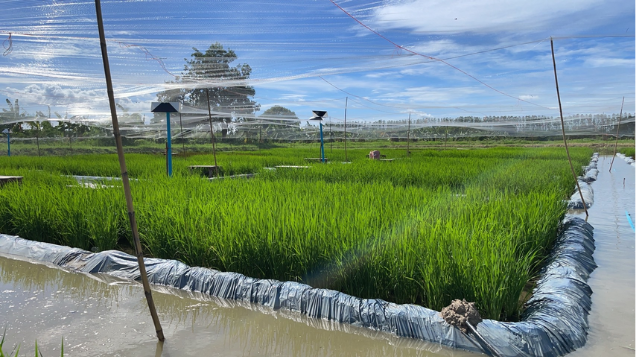
By then we faced small yet practical challenges, and they shaped how we implement our research realistically. Writing them down and planning around them became part of the science experiment and a reminder that even simple designs must bend to field conditions.
By September, drone flights were underway, and the work shifted to verifying the kind of imagery we collected. Our follow-up visit to the Rice Science Center showed what the season had thrown at the team: storms and strong winds had bent or flipped several floating targets and pushed fishnets onto them. A change in one setting for the positioning system also meant that images from one day no longer lined up neatly with earlier flights.
Rather than accepting these as unlucky events, we used the incidents as opportunities to improve our routine. We adjusted flight speed and image overlap, trimmed the area that needed to be covered, and reduced each mission’s duration. We agreed on simple ground rules, such as keeping the same reference point every time, retaking calibration images when light conditions change, avoiding shadows on the calibration board, flying in the cooler morning hours, and including flights at different water levels. Extra checks on the height of floating targets also helped interpret the images later. We also looked beyond single experiments and talked about a wider drone community with the Rice Department. We explored giving life to a small drone working group between IRRI, KU, and the Rice Department. It is a first step toward making drone use a normal part of rice research in Thailand.
Field details reshape experiments
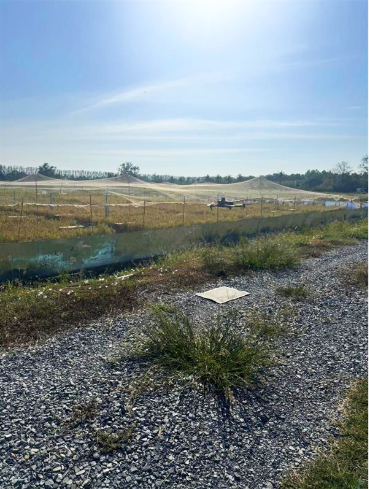
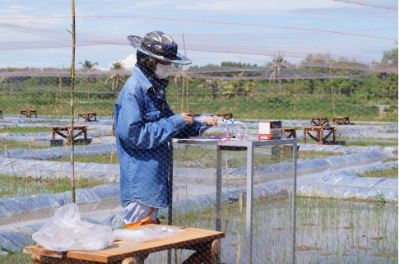
Later the same month, back at Kamphaeng Saen, a second visit gave us a chance to watch gas sampling when the crop was at the tillering stage. The chambers, fans, and thermometers worked well, and sampling teams moved smoothly through the plots. The visit also revealed details that matter for data quality. The bridges allowing for traversing the rice fields sat higher than was comfortable, and some chamber bases were so deep that water inside them did not match the surrounding field. Yet this is where theory meets reality. From then on, water levels were recorded both inside the chambers and in nearby tubes, and plots were marked where clear differences had been noted. Learning from this, plans were made to build lower bridges and to allow water to balance near each chamber in the future.
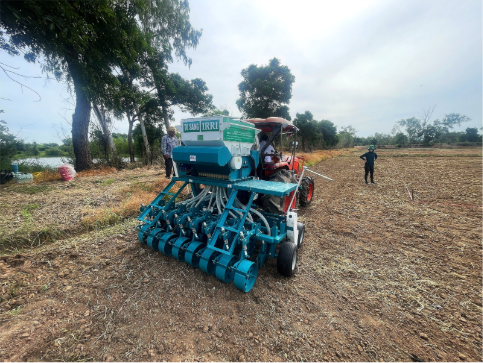
By October, attention turned to a different way of growing rice by means of dry mechanised direct-seeded rice in Lopburi. Seeds were drilled into dry soil with a machine instead of being transplanted into standing water. Managed well, this can reduce methane emissions and save water. During the visit, we inspected the plots, and confirmed that data collection was on track, including root sampling about a month after sowing. The crop was approaching panicle initiation, and no serious problems with weeds, pests, or diseases were observed.
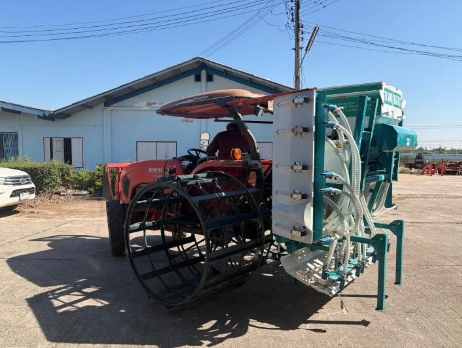
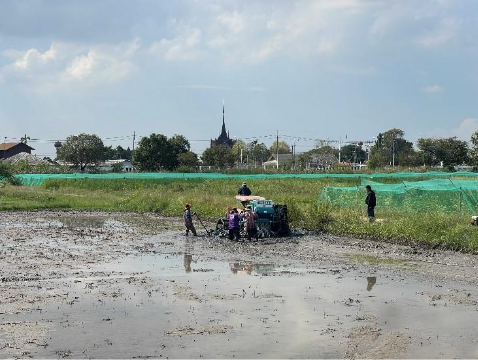
Similarly, in early December, we travelled to Ayutthaya Rice Research Center to plan a wet mechanised direct-seeded rice (wet mDSR) experiment together with the Center’s director and research team. This time the field was still bare, which meant we could walk the plots and adjust the design before any seed went into the ground. We finalised our experimental design with three treatments – conventional broadcast seeding, machine direct seeding, and machine direct seeding combined with fertiliser deep placement. Together we walked through the list of measurements that will be taken, noted that soil samples had already been collected, and agreed to implementing our data collection in the dry season and in the wet season.
By mid- December, the partners came together again for a final Thai Rice planning workshop to take stock of the year and agree on going forward and into 2026. The Rice Department underlined the ambition to support more than 200,000 farmers to adopt climate-smart practices that lower emissions while maintaining or improving production efficiency, and to make Thai rice more visible globally in a way that also strengthens farmers’ livelihoods. The representatives from GIZ, Rice Department, and others emphasised how closely the project partners depend on each other’s progress, stressing that the national agriculture agencies are central to reaching large numbers of farmers. IRRI, for its part, will embed technical innovations into existing farming systems.
The last discussion for 2025 reinforced that farmer knowledge is the central pillar of the project, with partners working on training materials and digital tools, improving access to finance and insurance for climate-smart practices, linking farmers to straw and biomass value chains, and shaping an enabling policy environment supported by a simple monitoring, reporting and verification system.
Over one season, IRRI and our research partners have strengthened a farmer survey, set up and refined key greenhouse gas experiments, turned drones into a working field tool, and prepared the seed experiments for the coming season. None of this unfolded exactly as written in the original plans, and that is the point: the small adjustments along the way have made the work more realistic so the evidence will be more robust. We are confident that this groundwork will help Thailand move from ideas about climate-smart rice to decisions based on real evidence.
ABOUT THE AUTHOR:
Christian Dohrmann is a consultant project manager and communications specialist with the International Rice Research Institute (IRRI) Thailand Office. He works with partners across Southeast Asia on greenhouse gas reduction, monitoring, and climate-smart rice initiatives, including the Thai Rice GCF project. His background spans three degrees in social sciences, cultural studies, and environmental sciences with international development experience from the United Nations in social development, SDG 4 monitoring, development statistics, public budgeting, as well as environmental education. He uses this broad experience to bridge practice, data, and policy with a focus on turning complex evidence into practical guidance.