A global meta-analysis of 245 studies from 34 countries delivers the first realistic benchmark for zinc, iron, and protein in rice grain — and a clear message for breeders, agronomists, and rice-eating families alike: neither better genetics nor better fertilizer alone gets rice nutritious enough. Combined, they finally start to close the gap.
By Panneerselvam Peramaiyan, Kazuki Saito, and Kalimuthu Senthilkumar
FAST FACTS
▪ A first-of-its-kind global meta-analysis: 245 published studies, 34 countries, more than 3,600 rice genotypes.
▪ Without any zinc or iron fertilizer, only 4% of polished-rice samples reached the zinc target and 10.5% reached the iron target set for human nutrition.
▪ Fertilizing with zinc and iron raised those odds to 41.3% and 67.7%, respectively.
▪ Zinc-biofortified varieties carry about 10% more grain zinc than ordinary varieties — but iron-biofortified varieties showed no measurable edge.
▪ Milling brown rice into white rice strips away roughly 32% of its zinc, 67% of its iron, and 8% of its protein.
▪ Zinc fertilizer lifted grain yields by up to 29% while simultaneously enriching the grain — nutrition and yield rising together, not trading off.
Rice has been getting bigger yields — and thinner nutrition
Rice feeds more than half the people on Earth. It supplies 19–21% of the world’s calories and about 15% of its protein, and for hundreds of millions of low-income households it is not just a staple, it is nearly the whole plate. That outsized role makes a stubborn problem hard to ignore: milled rice is naturally low in zinc, iron, and protein, and decades of breeding aimed squarely at yield have not helped. Earlier work tracking nutrient density in rice and wheat over the past half-century found that concentrations of zinc and iron fell by 20–50% after the high-yielding, semi-dwarf cultivars of the 1960s replaced older, long-straw varieties. More grain, less nutrition per bite — a trend our new analysis confirms is still running in the wrong direction for zinc even now.
For the roughly one in three people worldwide affected by zinc or iron deficiency, that matters. “Hidden hunger” — enough calories but not enough micronutrients — shows up as impaired child growth and cognition, weaker immunity, and anemia, hitting hardest the populations most dependent on rice. Biofortification has been promoted for two decades as a fix. What has been missing is a clear, global picture of how close that fix has actually come to working.
The scorecard: 245 studies, one sobering number
An international team led by Kalimuthu Senthilkumar of AfricaRice — including both of us, alongside colleagues across other partner institutions — pulled together data from 245 peer-reviewed studies spanning 34 countries and more than 3,600 rice genotypes: the largest synthesis of its kind to date. Our goal was to establish, for the first time, real-world benchmark concentrations of zinc, iron, and protein in rice grain, and to check them against the breeding targets nutritionists set years ago: 28 milligrams of zinc and 15 milligrams of iron per kilogram of polished rice.
The number that should worry anyone tracking global nutrition targets: in polished, white rice grown without added zinc or iron fertilizer, only about 4% of samples reached the zinc target, and just 10.5% reached the iron target. The median grain zinc concentration in white rice worked out to 17.5 mg/kg — well under the 28 mg/kg goal. Progress toward these breeding targets has been slow, and the breeding target for iron, in particular, appears to have been quietly abandoned — it no longer even shows up as a formal benchmark in recent literature.
“We have had breeding targets for zinc and iron in rice for more than a decade, but almost no one had checked how close the world’s rice actually comes to them. Pulling together 245 studies gave us that answer for the first time, and it is a wake-up call: breeding alone was never going to get us there. We need agronomy working alongside genetics, not as a backup plan.” — Kalimuthu Senthilkumar, AfricaRice, lead author
Breeding moves the needle on zinc — but not, so far, on iron
Zinc-biofortified rice varieties did show a real, measurable advantage: about 9.8% more grain zinc than ordinary cultivars (24.8 vs. 22.6 mg/kg on average) when grown side by side under the same conditions. That is genuine progress from breeding programs that have released more than 40 zinc-biofortified cultivars to date. Iron told a different story. Only one iron-biofortified cultivar had usable data across the pooled studies, and it showed no significant iron advantage over standard varieties.
Part of the explanation lies in how strongly the environment shapes these traits. The heritability of grain zinc and iron concentrations was moderate to high across the studies reviewed (median broad-sense heritability of about 86.5% for zinc and 72.8% for iron), meaning genetics does set much of the ceiling. But genotype-by-environment interactions — how a variety performs differently depending on soil, season, and management — explained a significant share of the remaining variation for both nutrients. In practice, that means a zinc- or iron-rich variety planted in the deficient soil, or without the right fertilizer inputs, will not automatically deliver the grain quality it was bred for.
Fertilizer does the heavy lifting
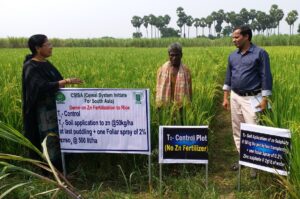
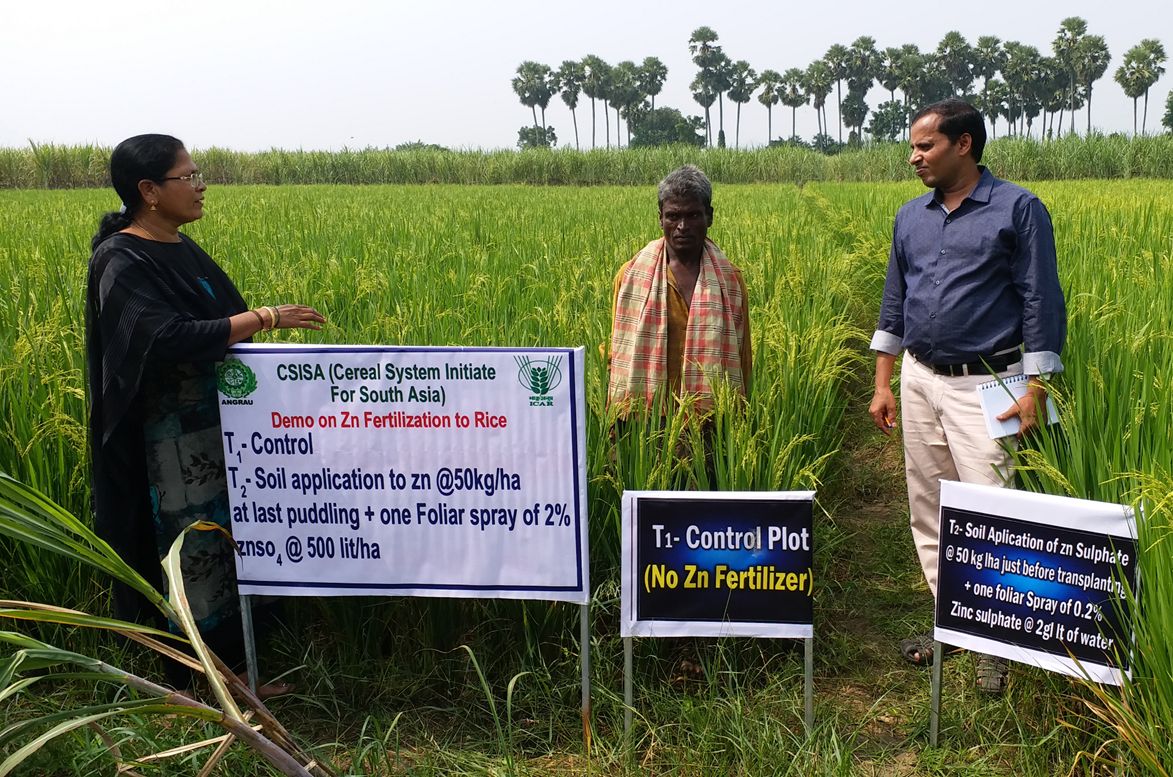
This is where agronomy stepped in and changed the numbers substantially. Applying zinc fertilizer — as a soil treatment, foliar spray, seed coating, or some combination — alongside standard NPK fertilizer raised grain zinc concentrations by an average of 44%, on top of a 17% increase in grain yield. The best-performing combination, soil plus foliar zinc together, pushed grain zinc up by as much as 88% in some trials. Zinc-treated plots also saw protein rise by about 7% and phytate — the antinutrient that locks up minerals — fall by roughly 8%.
Iron fertilizer worked similarly: grain yields up 20%, grain iron up 25%, grain zinc up 22% (the two minerals move together in the plant), and protein up 31%. Across the dataset, adding zinc and/or iron fertilizer more than tripled the odds of a polished-rice sample actually reaching its nutrition target — from 4% to 41.3% for zinc, and from 10.5% to 67.7% for iron. Growth-promoting rhizobacteria combined with zinc-solubilizing bacteria produced the single largest jump in grain iron concentration of any treatment tested, a sign that biological approaches to nutrient delivery deserve more attention alongside conventional fertilizer.
There is a practical ceiling, though. Response curves flattened above roughly 30 kg of zinc per hectare, and because zinc fertilizer is costly and not always accessible to smallholders, we point to modest applications of 5–10 kg Zn/ha as the more realistic recommendation. We also flag a less obvious risk: phosphorus rates above about 80 kg P/ha tended to depress zinc uptake, a reminder that fertilizer programs optimized purely for yield can work against nutrition goals. The benefits held up across nearly every soil and climate type tested, but were largest on soils already identified as zinc-deficient — reassuringly, the input works hardest exactly where the need is greatest. Irrigated rice responded more strongly to zinc fertilization, while rainfed systems responded more strongly to iron, likely reflecting how flooding changes each nutrient’s availability in the soil.
“Genotype, environment, and management together decide how much zinc and iron end up in the grain — none works alone. Closing this gap means breeders and agronomists finally thinking in terms of G×E×M, together.” — Panneerselvam Peramaiyan, IRRI, co-author
The milling problem: undoing the gains at the mill
Here is the catch that could undercut everything gained through breeding and fertilizer: polishing brown rice into the white rice most consumers eat strips out a large share of exactly the nutrients this whole effort is trying to preserve. Averaged across studies, milling and polishing removed about 32% of grain zinc, 67% of grain iron, 8% of protein, and 42% of phytate. And the loss escalates quickly with the degree of milling: in one detailed study of landrace rice from Manipur, India, a light 5% milling removed 12.5% of zinc and 41.8% of iron, but pushing milling to just 10% nearly doubled those losses, to 19.8% and 61.3%.
In other words, a farmer growing a zinc-biofortified variety, fertilized correctly, can still end up serving a bowl of rice that has lost much of that advantage simply because of how the grain was processed. Whole-grain brown rice avoids this loss entirely but is often perceived, fairly or not, as “poor man’s food” in parts of Asia and eaten mainly by older generations — a cultural hurdle biofortification programs will need to address alongside the biology.
Parboiling: an old technique with new relevance
One processing method stood out as a middle path: parboiling. Soaking rough rice in hot water, then steaming and drying it before milling, drives water-soluble nutrients from the bran into the endosperm, where milling can no longer remove them. Parboiled rice retains more minerals and B vitamins than ordinary milled rice, along with lower phytic acid. We explicitly recommend promoting parboiled rice among populations for whom rice is the dominant staple — a low-cost, already-familiar intervention that needs no new variety or fertilizer program to scale up. Related work at AfricaRice and the Fortified Whole Grain Alliance on mild hydrothermal stabilization of brown rice — controlled soaking, steaming, and low-temperature drying — shows early promise for retaining even more minerals while keeping the grain more palatable than traditional brown rice.
Why the numbers on the label are not the whole story
Even a grain that meets its zinc or iron target on paper does not guarantee the nutrient reaches the person eating it. Phytic acid, rice’s natural phosphorus-storage compound, binds zinc and iron in the gut and blocks their absorption. Researchers use the phytate-to-mineral molar ratio as a proxy for bioavailability — ratios above 15 signal poor absorption. Across the pooled data, rice grain averaged a phytate-to-zinc ratio around 27 and a phytate-to-iron ratio around 30, both solidly in the “low bioavailability” range.
Zinc and iron fertilization improved both ratios substantially — cutting them by roughly a third to two-thirds — not by lowering phytate itself, but by raising mineral concentrations enough to dilute its effect. That makes fertilization a useful short-term lever for bioavailability, while the more durable fix will be breeding rice with optimized, not simply minimal, phytate levels — phytate also helps seeds germinate and establish, so it cannot be bred away entirely.
What this means for breeders, agronomists, and farmers
Our bottom line is a call to stop treating genetics and agronomy as competing strategies. Breeding sets the ceiling for how much zinc or iron a variety can accumulate; fertilization and soil management determine how close the crop actually gets to that ceiling in a real farmer’s field. We lay out three practical priorities: first, pair biofortified varieties with targeted zinc and/or iron fertilization rather than relying on genetics alone; second, adjust post-harvest handling — moderate milling, parboiling, controlled drying, and hydrothermal stabilization of brown rice — to stop losing at the mill what was gained in the field; and third, promote parboiled rice consumption specifically among the populations most dependent on rice as a daily staple.
For national breeding programs, the message is to keep pushing on iron biofortification, where genetic gains have lagged behind zinc, and to explore newer tools such as zinc-oxide nanoparticle fertilizers, absorbed more efficiently by rice roots in early trials. For extension services, we argue for right-sized, affordable zinc applications (5–10 kg/ha) on soils already tested as zinc-deficient, rather than blanket recommendations that price out the farmers who would benefit most.
The bigger picture
This meta-analysis does not close the case on rice biofortification — it sharpens the open questions, especially around managing genotype-by-environment-by-management interactions and tracking bioavailability routinely. But it gives rice research something it has lacked: a realistic, evidence-based global baseline instead of aspirational targets nobody had checked against. For a crop that feeds half the planet, knowing exactly how far there still is to go — and that the road runs through genetics, fertilizer, and the mill all at once — is itself real progress.
READ THE FULL REVIEW:
Kalimuthu Senthilkumar, Dominic Mutambu, Gudeta Weldesemayat Sileshi, Panneerselvam Peramaiyan, Kazuki Saito, Mina Devkota, Ali Ibrahim, Justin Fagnombo Djagba, Sali Atanga Ndindeng, Prem S. Bindraban, and Job Kihara
Integrating genetic and agronomic fortification improves zinc, iron, and protein concentrations in rice grain: a meta-analysis.
npj Sustainable Agriculture 4:66 (2026).
https://doi.org/10.1038/s44264-026-00180-7