- Google’s new gravity drip irrigation pilot showcased how the technology can significantly cut water use and emissions while slightly increasing yields
- The proof-of-concept addressed previous barriers such as off-grid power, sediment clogging, and nutrient issues
- Through research partners like IRRI, translating this technology to water-scarce Global South regions can make rice systems more climate-resilient
By Rehana Noor
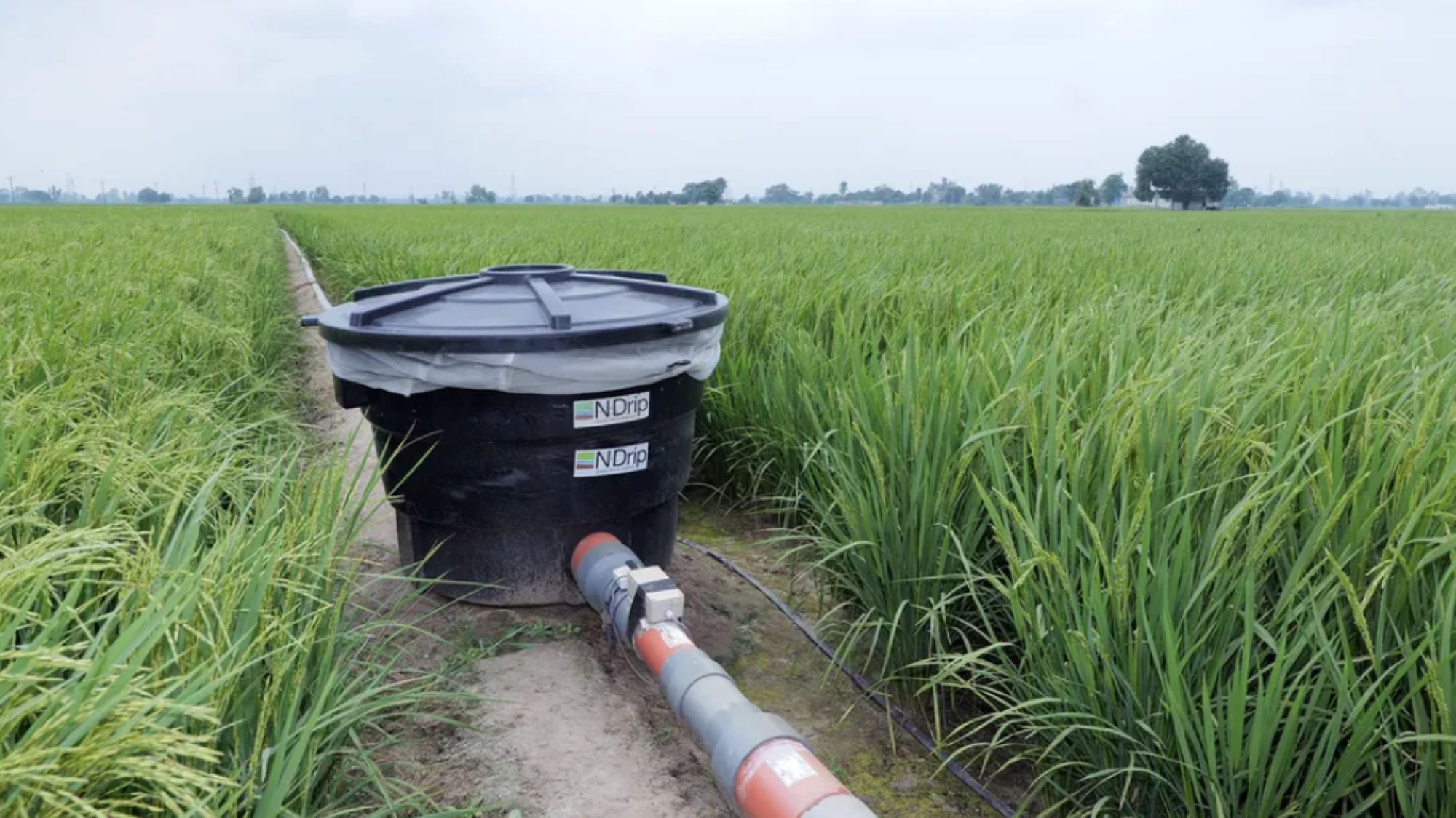
As AI data centers drive up demand for water and electricity around the world, a gravity-powered drip irrigation pilot backed by Google in Taiwan is showing how rice farmers can use 57% less water, emit over 80% less methane, and still grow more grain—pointing to a water-positive pathway for rice economies across the Global South.
Rice is humanity’s most important staple food, feeding over 4 billion people—more than half of the world’s population—and supporting around 150 million farmers across 100 countries. Yet despite technological progress, rice cultivation still accounts for an estimated 1.5% of global greenhouse gas emissions and consumes about 30% of the world’s freshwater resources, requiring up to 5,000 liters per kilogram produced and further straining water-stressed regions in the Global South.
To address these challenges, one promising avenue is the application of modern technologies to agricultural irrigation to improve water-use efficiency.
Precision water management: drip irrigation
Recent technological advances have positioned drip irrigation as a potentially transformative approach to rice cultivation. In drip irrigation systems, water is delivered directly to the root zone via valves, pipes, and emitters, typically installed below ground. This method maintains optimal soil moisture without saturating the soil.
Key components of drip irrigation in rice fields include:
Subsurface drip irrigation (SDI): Pipes are usually buried 10–20 cm below the soil surface, reducing water loss, improving water-use efficiency, and allowing farm machinery to move more easily during harvest.
Fertigation: Because water is applied directly to the root zone, fertilizers can be delivered through the irrigation system, ensuring timely nutrient supply and supporting improved plant growth.
Sensors: Soil moisture sensors trigger irrigation only when moisture levels fall below a defined threshold, helping conserve water while ensuring adequate moisture for plant growth.
The N-Drip and Google pilot in Taiwan
Google is advancing innovative water stewardship initiatives in collaboration with public and private stakeholders in Hsinchu and Changhua City, Taiwan, as part of its broader environmental, social, and governance (ESG) strategy.
The tech giant is integrating its water sustainability objectives with its clean energy commitments in Taiwan. In partnership with the Israeli agri-tech firm N-Drip, Google has launched a precision drip irrigation pilot for rice cultivation in Changhua City, funded through a multi-million-dollar water stewardship portfolio.
The pilot began in spring 2025 and covers approximately 24 hectares near Google’s primary data center in Changhua City. The project aims to reduce water consumption and labor requirements and to generate robust evidence on resource savings to support wider adoption across rice-growing regions.
At an event held at National Chung Hsing University on 8 October 2025, experts presented results from the first growing season. Compared with conventional flood irrigation, the N-Drip system achieved 57% water savings, a 5.4% increase in rice yield, and reductions of more than 80% in methane emissions.
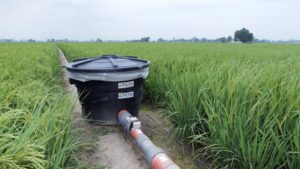
The gravity-powered system operates without high-pressure pumps or expensive filtration. Integrated artificial intelligence and real-time sensor analytics help farmers optimize irrigation and fertilization, enhancing water and energy efficiency, lowering carbon emissions, and improving crop yields. Stakeholders indicated that this pilot could substantiate the water-saving potential of similar projects and inform strategies for scaling the solution.
Translating the technology for the Global South
Drip irrigation is expected to become increasingly important in rice cultivation, particularly in water-scarce regions of the Global South, including Bangladesh, India, Southeast Asia, and parts of Africa. This transition is driven by the urgent need for more efficient water management and more sustainable production systems.
However, the adoption of drip irrigation in rice has faced several barriers, including high upfront costs for pipes, pumps, and filters; challenges in weed management; and iron deficiency in rice grown in aerobic soils, which can lead to chlorosis.
N-Drip’s gravity-based micro-irrigation system addresses some of these constraints by using natural field slopes to transport water without electricity or fuel. The system delivers water directly to the root zone through drippers, eliminating the standing water layer typical of flooded rice systems. A specialized leaching mechanism helps prevent sediment, commonly found in agricultural canals, from clogging drip lines, while soil moisture sensors can activate irrigation only when needed. In addition, this technology promotes the activity of methanotrophic bacteria that consume methane before it is released to the atmosphere and may help immobilize arsenic in aerobic soils.
The successful deployment of N-Drip’s system in Bangladesh and India will depend on several critical implementation steps. These include selecting rice varieties suitable for non-flooded conditions, designing pipe layouts to minimize installation costs, burying pipes to prevent physical damage, and adapting fertilizer management to address iron deficiency and other nutrient constraints.
The Taiwan proof-of-concept demonstrates how strategic innovation can reshape rice cultivation in the Global South. Implemented by N-Drip with funding from Google, the project has the potential to help rice producers shift from being net methane emitters to generators of carbon credits, open new markets for drip-irrigated rice with lower arsenic levels, and support off-grid farms that use water more efficiently. These outcomes align with Google’s water stewardship goals and with farmers’ need to stretch limited water resources further.
Sustainable agrifood systems supported by tech
Many AI data centers still depend on freshwater for cooling. To achieve net-zero targets, companies such as Google and Microsoft are adopting closed-loop liquid cooling systems. At the same time, to ensure data sovereignty, technology firms are rapidly establishing regional AI data centers in many countries. To accelerate meaningful progress in the rice-producing regions of the Global South, it is essential to move quickly from isolated N-Drip technology pilots to a coordinated, large-scale initiative.
Enabling this transformation will require the adoption of advanced technologies, the use of targeted policy incentives, and strengthened community participation. The International Rice Research Institute (IRRI) can play a leading role in driving these efforts in rice-growing areas of drier regions, including South Asia—particularly Bangladesh’s Barind region—as well as other suitable environments across Asia and Africa. With support from data and technology companies, such initiatives can help establish a more sustainable, climate-resilient, and future-proof rice-based agrifood system.