• Researchers have identified chemicals that block the INO1 enzyme, which produces “anti-nutrient” phytic acid, a natural substance in grains that prevents the body from absorbing iron and zinc.
• Applying these chemicals as a spray reduced phytic acid by 31% in rice and 47% in wheat grains without the yield penalties caused by traditional genetic methods
• Because the target enzyme is similar across many crops, this strategy could be a universal solution to boost the nutrition of other staples like maize, soybean, and barley
By Dr. Rhowell Tiozon Jr., Prof. Dr. Alisdair R. Fernie, Dr. Nese Sreenivasulu, and Glenn Concepcion
The global fight against malnutrition faces a persistent and invisible enemy: “hidden hunger.” This condition occurs when individuals consume enough calories—primarily from staple cereal crops—but remain deficient in essential micronutrients like iron and zinc. The scale of the crisis is immense; for example, zinc deficiency alone is responsible for over 800,000 deaths annually, including children under the age of five.
A recent analysis by researchers from Toyo University and others has highlighted a chemical genetic strategy that could finally decouple nutritional enhancement from the agricultural yield penalties that have long stymied progress in this area.
Phytic acid, the “anti-nutrient”
The primary barrier to mineral absorption in cereal-based diets is a molecule called myo-inositol hexaphosphate, commonly known as phytic acid (PA). In the plant world, PA is indispensable; it serves as the major storage form of phosphorus in the seed, accounting for roughly 70% of total phosphorus.
However, when consumed by humans, PA also acts as a potent “anti-nutrient.” It tightly binds to minerals like iron and zinc, creating a chemical complex that the human digestive tract cannot absorb. Consequently, populations that rely heavily on cereals often suffer from micronutrient deficiencies, even if they consume enough calories.
For decades, agricultural scientists have attempted to create low-phytic acid crop varieties through traditional breeding or genetic engineering. While these efforts succeeded in reducing PA, they almost always came at a steep cost to the plant’s health, leading to stunted growth, lower grain weights, and poor germination rates.
Finding a precise chemical inhibitor
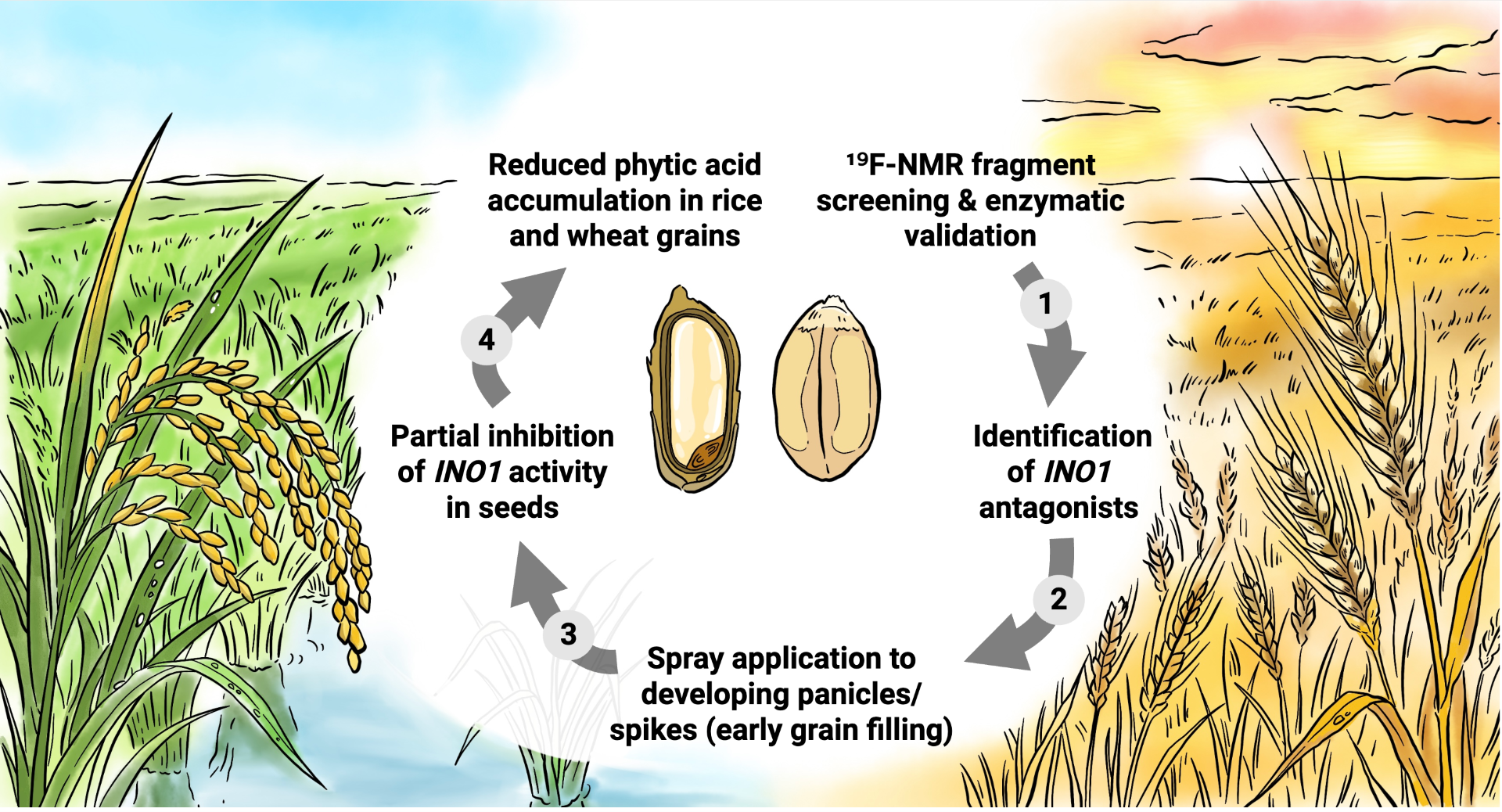
The core of this new strategy involves using small chemical molecules to transiently “turn off” a specific enzyme called myo-inositol 3-phosphate synthase 1, or INO1. This enzyme is responsible for the very first step in the production of phytic acid, and by targeting the enzyme directly with chemicals rather than permanently altering the plant’s DNA, researchers can now control when and where the inhibition occurs.
The genius of the application lies in its timing. Instead of treating the plant throughout its entire life cycle, these chemicals are applied as a targeted spray directly to the developing panicles (the grain-bearing heads of the plant) during the early grain-filling stage. This stage-specific intervention allows the plant to grow, flower, and develop normally, only slowing down the production of phytic acid when the grain is actually maturing.
The results of the experiment were significant. In rice, the phytic acid content dropped by up to 31%. In wheat, the results were even higher, with a reduction of up to 47%. Crucially, because the total amount of zinc and iron in the seeds remained unaffected by the treatment, the reduction in phytic acid meant that the bioavailability of these minerals essentially doubled. Unlike genetic modifications, this pharmacological approach resulted in no alterations to grain weight, ear weight, grain number, or the ability of the seeds to germinate.
A universal tool for staples worldwide
One of the most promising aspects of this research is its potential for broad application. The INO1 enzyme is highly conserved across the plant kingdom, meaning its structure is very similar regardless of the species. For instance, wheat INO1 shares over 95% amino acid similarity with rice INO1.
Because of this similarity, the authors suggest that this “chemical switch” could be used to enhance the nutritional value of a wide variety of other staple crops, including maize, soybean, barley, and sorghum. This makes chemical genetics a precision tool for modulating plant metabolic pathways, similar to recent breakthroughs that use chemical signaling to improve drought resilience in wheat.
Integrating into global food strategies
To transition from proof of concept to field deployment, this strategy must be validated across diverse environments, seasons, and genetic backgrounds, alongside rigorous toxicological and regulatory assessments. Clinical feeding trials will also be essential to confirm that reduced phytic acid translates into improved mineral bioavailability in human populations.
Importantly, this chemical strategy complements, rather than replaces, ongoing genetic and breeding efforts to combat hidden hunger.
At the International Rice Research Institute (IRRI), Dr. Inez Slamet-Loedin and her team have led pioneering work in stacking multiple micronutrients, including high iron, zinc, and provitamin A, into elite rice backgrounds. This multi-nutrient biofortification approach aims to address several deficiencies simultaneously, especially in regions where rice is the primary staple.
Parallel to this, IRRI’s Consumer-Driven Grain Quality and Nutrition group, led by Dr. Nese Sreenivasulu with Dr. Rhowell Tiozon Jr., has undertaken large-scale pre-breeding efforts by screening more than 2,000 rice accessions from the IRRI Genebank to identify lines with inherently high iron and zinc concentrations. These efforts seek to unlock natural genetic variation as a foundation for next-generation biofortified varieties.
In collaboration with the Max Planck Institute of Molecular Plant Physiology, the same team has also demonstrated that post-harvest interventions such as germination can enhance mineral bioavailability. Germination was shown to increase iron and zinc levels, elevate beneficial micronutrients, and reduce phytic acid—offering a complementary, food-based strategy to improve nutritional outcomes.
“Integrating chemical strategies to reduce phytic acid and enriching multiple micronutrients through biofortification to enhance bioavailability of nutrients in the staple diet is an emerging opportunity to address micronutrient deficiency in Asia and Africa,” said Dr. Sreenivasulu.
“This approach allows us to enhance mineral bioavailability without compromising yield. It opens a new dimension in crop nutrition—where timing and precision matter as much as genetics,” shares Dr. Tiozon Jr.
“These findings allow that a simple, timely chemical application has profound implication on grain nutrition and thereby have immense potential for global agriculture” states Prof. Dr. Alisdair Fernie.
Strengthening both global food and nutrition security
Chemical genetics offers a powerful bridge between crop innovation and human health, with the potential of providing a precise and efficient means to enhance the nutritional quality of staple grains around the world. Integrated into the work of CGIAR centers, this innovation can complement biofortification and genomic selection strategies, improving both yield stability and nutritional outcomes.
For populations that rely heavily on a single staple crop, these enhancements in micronutrient content can help ensure that the world’s most vulnerable populations receive the full nutritional benefit of the grains they consume.
Read the papers:
Tatsuki Akabane, Satoshi Kamino, Tomoki Okamura, Atomu Sugaya, Momona Nakamura, Kazuyoshi Ikeda, Tomoki Yonezawa, Ayaka Fukushima, Shota Kojima, Yota Aoki, Sakura Chujo, Yusei Yamauchi, Rioko Shibusawa, Ken Ishimaru, Seiji Nagasaka, Etsuko Katoh, Naoki Hirotsu
Chemical inhibition of INO1 reduces phytic acid in rice and wheat grains for enhanced micronutrient bioavailability
Nature Food volume 7, pages163–173 (2026)
https://doi.org/10.1038/s43016-026-01295-3
Rhowell Tiozon Jr., Nese Sreenivasulu, Alisdair Fernie
Chemical strategies for mineral bioavailability
Nature Food, 124–125 (2026)
https://doi.org/10.1038/s43016-026-01308-1