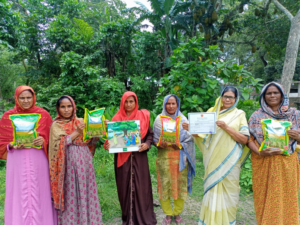
- Agricultural innovations are most effective for women when bundled with social and institutional support
- In these case studies, women were able to transition from being mere laborers into actors and decision-makers
- To avoid unforeseen risks, bundled innovations should not be ad hoc, but planned systematically with farmers and the community
By Glenn Concepcion

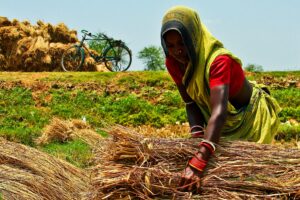
In the varied landscapes of South Asia, the frontline of the climate crisis isn’t just found in weather reports, it’s also in the hands of the millions of women who till the soil. Despite their central role in the agricultural workforce, women farmers often face “gender-blind” systems that provide them with new tools without considering the social barriers that they must surmount to use them.
A new study ,conducted by a team of researchers from the International Rice Research Institute (IRRI) and published in Frontiers in Sustainable Food Systems, argues that if we want to build true climate resilience, we must stop handing out isolated technologies and start delivering “innovation bundles”.
The research suggests that the traditional top-down model of agricultural extension—where experts simply transfer a finished technology to a farmer—is failing women. Instead, the study advocates for a socio-technical approach. This means recognizing that a seed or a tractor is not just a neutral technology; its success depends on the social relations, cultural norms, and institutional power dynamics of the community where it is planted.
To demonstrate this, the study analyzed four distinct case studies across India, revealing how the strategic bundling of technical, social, and institutional support can enable the effective and sustainable transformation of women farmers towards climate resilience.
Gujarat: fighting salinity by learning science and land rights
In the saline marshlands of Bhavnagar, Gujarat, the organization Utthan (in a study conducted by the Institute of Social Studies Trust) recognized that environmental stress and social inequality are inseparable. Women in this region struggle with soil salinity, but they also struggle with a lack of legal standing. Without land rights, they cannot easily access government credit or long-term agricultural resources.
The innovation bundle for Utthan was unique because it paired sustainable farming techniques, like soil testing and organic fertilizers, with socio-legal empowerment. They trained “Krushi Sakhis” (women community resource persons) and paralegal workers who operated out of block-level revenue offices. The paralegals helped women navigate the bureaucracy of land registration, while the Krushi Sakhis taught them a Package of Practices (PoP) for their crops. This approach created a “sisterhood” where women learned from their peers, significantly boosting their confidence and their credibility in the eyes of their husbands.
Uttar Pradesh: building knowledge and markets for mustard
In the northern plains of Uttar Pradesh, the Grameen Foundation of India (GFI) introduced Pusa Mustard 30, a biofortified variety designed to be water-stress resilient and nutrient-dense. However, the researchers noted that simply providing a better seed is useless if a woman has no way to sell her harvest at a fair price.
GFI’s innovation bundle focused on institutional anchoring. They worked through Farmer Producer Organizations (FPOs) and Self-Help Groups (SHGs) to provide technical training alongside market linkages. By organizing exposure visits to Banaras Hindu University, they democratized scientific expertise, allowing women to interact directly with experts. While the project faced challenges in maintaining these market links, the collective engagement through SHGs helped women voice their opinions more clearly within their households and communities.
Maharashtra: nurturing diverse crops and decision-making
In the semi-arid region of Dharashiv, Maharashtra, Swayam Shikshan Prayog (SSP) implemented the Women-Led Climate Resilient Farming (WCRF) model. This project was revolutionary because it intentionally shifted the focus from high-input cash crops to diversified food crops like millets and vegetables using local, water-intensive practices.
The SSP bundle was designed to address the essential identity of the woman farmer. By positioning women as the primary decision-makers and innovators, the model helped them transition from mere laborers to agricultural leaders. The bundle included leadership training, access to a Community Resilience Fund for micro-investments, and the creation of Krishi Samvad Sahayaks (KSS), women who facilitate communication between farmers and local government officials. The results were tangible: women reported a 10–15% increase in food-crop productivity and significant monthly savings, which in turn shifted household dynamics, with men increasingly recognizing their wives as equal partners.
West Bengal: breaking the machinery gap
In the Eastern Gangetic Plains of West Bengal, the Satmile Satish Club O Pathagar (SSCOP) focused on the technical hurdles of conservation agriculture. Through the Sustainable and Resilient Farming System Intensification (SRFSI) project, they introduced high-tech solutions like zero tillage, mechanical rice transplanting, and multi-crop planters.
While this project was initially less focused on gender, its inclusive training design allowed women to enter spaces where men usually dominate—heavy machinery. The bundle included training on fertilizer application, irrigation, and the business operations of custom-hiring centers, which allowed farmers to rent expensive equipment they could not afford to buy. The findings showed that when women were trained in these “masculine” technologies, they gained status as community role models, and over 80% of participants reported having a greater influence over cropping decisions.
Learning from your peers
The study’s most striking finding was the effectiveness of peer-to-peer learning. Across all cases, farmers were more likely to adopt new technologies when they saw “someone like them” succeeding.
In Gujarat, when men saw the tangible results of the Package of Practices implemented by their wives, their skepticism turned into support. One woman recounted that her husband, once dismissive of her meetings, eventually told her, “Do not worry about the household chores… focus on your meeting”. The social support of trust-building, collective action, and leadership training were the fertile soil that made the technologies take root.
Addressing hidden risks
Despite these successes, the sources offer a vital warning: innovation is not a silver bullet. The researchers identified several gaps in how these bundles were implemented. Often, the bundling was ad-hoc rather than intentional, with organizations focusing on the technology first, with the social support as an afterthought.
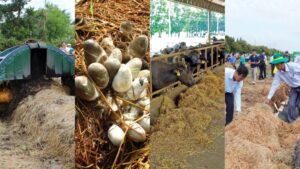
A major concern is the burden of unpaid care work. The study found that 60% of projects aimed at empowering women may actually worsen their work-life balance by adding new responsibilities. For instance, while organic farming (as seen in Gujarat) is climate-smart, the preparation of bio-manure and vermicompost is highly labor-intensive, potentially overburdening women who are already managing household chores and childcare.
Furthermore, the study highlights the danger of “gender washing”—superficial attempts to include women without addressing underlying power structures. In many cases (with the exception of SSP), there was a lack of engagement with men. If husbands and community leaders are not involved in the conversation, women may face backlash or be unable to participate in training because they are stuck at home doing household work.
Looking to the future
The study concludes that for climate-smart agriculture to be truly “smart,” it must be co-designed with the community. This requires a shift from just “transferring” technology to “weaving in” support systems that take into account women’s experiences.
To move forward, the authors emphasize that we must:
Analyze the clock: Systematically assess how new technologies affect a woman’s time and labor.
Involve everyone: Adopt gender-transformative approaches that engage men to redistribute household responsibilities.
Support the system: Ensure technology is anchored in land rights, market access, and collective platforms like SHGs.
By bundling the social with the technical and institutional, we can ensure that the next generation of climate-smart tools doesn’t just sit in a shed, but actually empowers the women who are the backbone of global food security.
As the researchers put it, “sustainable innovation emerges only when systemic arrangements (institutions, delivery mechanisms, incentives) and social relations (norms, identities, labor distribution, social learning) are transformed in tandem.”
Read the study:
Prama Mukhopadhyay, Deepali Chadha, Hom Nath Gartaula, Monika Banerjee, Ranjitha Puskur
Making climate-smart technologies work for women farmers: Insights from cases of bundling innovations in India
Frontiers in Sustainable Food Systems 10: 1648400.
https://doi.org/10.3389/fsufs.2026.1648400