
- A study evaluated the market performance of the Sustainable Rice Platform (SRP) label against established single-issue certifications like Organic, Fairtrade, and WWF.
- Consumers significantly preferred multi-labeling over a single SRP label, willing to pay double to triple the price for the multi-stamp combination.
- Researchers recommend a gradual transition strategy for SRP, where multidimensional labels are co-labeled with trusted origins or established stamps to build consumer credibility.
By Glenn Concepcion
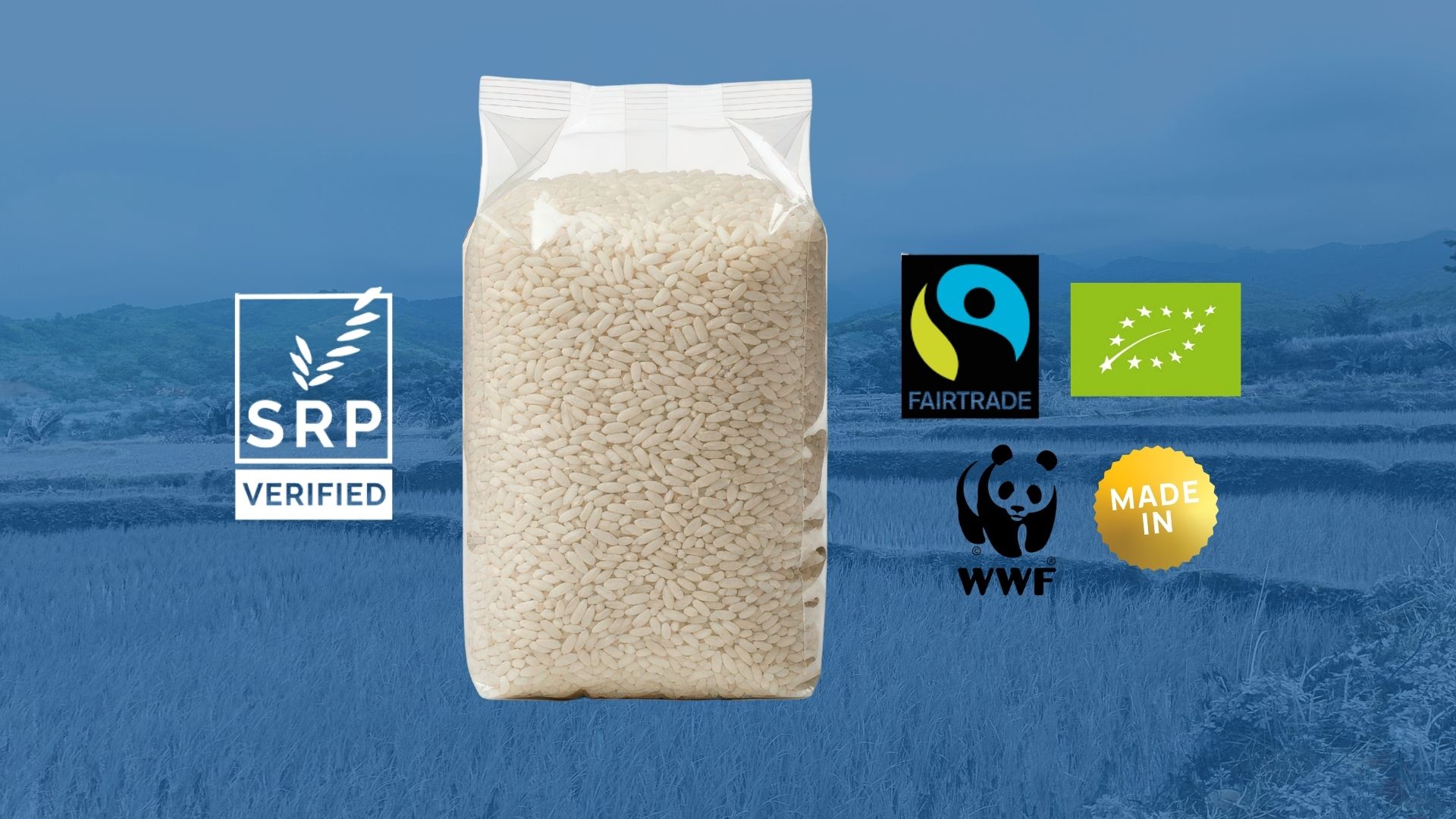
In the modern grocery aisle, consumers are often besieged by a long list of certifications, from Organic, Fairtrade, WWF (World Wildlife Fund), and more, all vying for attention on a single package of rice. While these symbols aim to guide ethical choices, their proliferation has led to an information overload, leaving many shoppers confused, skeptical, or simply exhausted.
A new study published in Food Quality and Preference by an international team of researchers from the University of Queensland, the International Rice Research Institute, Leuphana University, and IPB University investigate whether a single, multidimensional “Super-Label” can cut through the noise, or if consumers still prefer a crowded collage of familiar stamps.
The SRP Label
The research focused on the Sustainable Rice Platform (SRP), a holistic certification launched in 2015 that covers environmental, social, economic, and food safety dimensions. The researchers sought to determine if this all-encompassing label could replace the current practice of “multi-labeling,” or displaying several single-issue stamps simultaneously.
To test this, the researchers conducted a discrete choice experiment involving 507 German and 361 Singaporean rice consumers. Participants were asked to choose between different rice products characterized by varying price points, origins, and combinations of sustainability labels.
A tale from two markets: Singapore and Germany
The study revealed a stark geographic divide in how consumers value sustainability. In Singapore, a relatively unsaturated market for labels, the multidimensional SRP label was the top performer, commanding a price premium of US$0.58. Remarkably, Singaporean consumers valued the SRP label more than established single-issue labels like Organic or Fairtrade, and even more than the rice’s origin. This suggests that in emerging markets, consumers may be more receptive to a comprehensive “one-stop-label” for sustainability.
In contrast, Germany presents a saturated market where consumers are already deeply familiar with specific certifications. In the German market, the SRP label ranked third, trailing behind Fairtrade and Organic. German shoppers also prioritized EU origin over any sustainability claim, willing to pay a premium of US$0.46 just for local sourcing. This suggests that in mature markets, high levels of trust and familiarity with long-standing labels act as a barrier to new, complex certifications.
The more labels the better?
Perhaps the most surprising finding was that consumers in both countries still preferred a product with three separate labels (Organic, Fairtrade, and WWF) over a single SRP label. In Singapore, the willingness to pay for a multi-labeled product was nearly double that of the SRP label; in Germany, it was triple.
Why would consumers choose three labels over one that covers the same ground? The study suggests that “less is more” does not always apply to certifications. Shoppers may find it easier to process multiple simple, focused concepts than one complex, holistic label. There is also a “more is better” psychological effect, where a package crowded with certifications provides a greater sense of reassurance and perceived value.
The Quality Halo effect
The study also explored whether the SRP label could effectively substitute for single-issue stamps to reduce certification costs for producers. The results were mixed. While some “partial substitution” occurred, meaning the value of an Organic label decreased slightly when SRP was present, the SRP label could not fully replace established certifications. This is partly because Organic labels signify specific attributes, like the absence of synthetic pesticides, that the SRP label does not guarantee in the same way.
However, the researchers identified a powerful complementary effect. When the SRP label was paired with a trusted indicator like local origin, the perceived value skyrocketed. In Singapore, combining SRP with an Asian origin label resulted in the highest overall willingness to pay in the entire study. This “quality halo effect” suggests that consumers are more willing to trust a new sustainability claim if it is anchored by a familiar, credible signal of quality.
Certifying, the way forward
The findings have significant implications for the global rice industry, which faces high certification costs relative to the product’s low value as a basic staple. The study concludes that a gradual transition to multidimensional labels may be necessary. Rather than launching the SRP label in isolation, companies might find more success by co-labeling it with trusted symbols—such as Fairtrade in Germany or the WWF panda in Singapore—to build credibility through association.
As the food industry strives to meet the United Nations’ Sustainable Development Goals, understanding how to communicate these efforts to the public is vital. For now, it seems that while the “Super-Label” is a promising tool, the era of the crowded, multi-stamped rice bag is far from over.
Read the study:
Julia Checco, Matty Demont, Leonard V. Coote, Maureen Schulze, Risti Permani, Yanti Nuraeni Muflikh, Jaquie Mitchell, Ammar Abdul Aziz
Do consumers prefer multidimensional or multiple single-issue sustainability labels? Evidence from rice markets in Germany and Singapore
Food Quality and Preference, Volume 137, 2026
https://doi.org/10.1016/j.foodqual.2025.105812