- Tania converted her flood- and salinity-prone rice field in coastal Bangladesh into a thriving sorjan-based vegetable farm—a nature-based solution.
- By diversifying crops on raised beds and managing water through canals, she increased her net annual income fivefold while improving land productivity, family nutrition, and livelihoods.
- As her farm’s success grew, Tania became a local role model, inspiring other women to adopt sorjan farming and challenging gender norms in agriculture.
By Mou Rani Sarker and Humnath Bhandari
Across the coastal deltas of Bangladesh, agriculture is increasingly shaped by water management and climate adaptation. Salinity intrusion, seasonal flooding, and unpredictable rainfall often disrupt traditional farming systems, making crop production uncertain for many smallholders. Yet in these climate-vulnerable landscapes, farmers are finding ways to adapt by working with nature rather than against it.
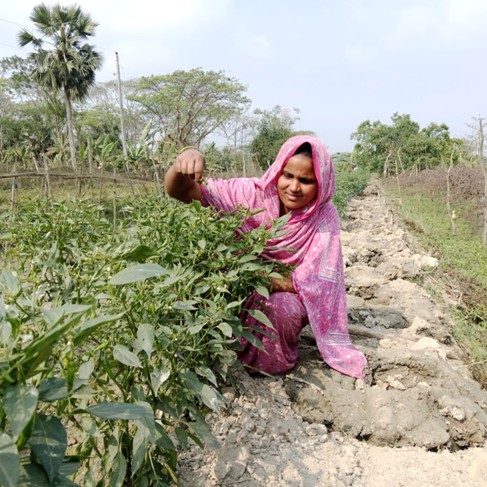
One such farmer is Tania Akter, a 35-year-old wife and mother who has transformed her small plot into a productive sorjan-based farm, showing how climate-resilient agriculture can strengthen livelihoods while challenging gender barriers in rural communities.
Working with water, not against it
Tania lives with her husband and two children in Kallanpur, a coastal village in Kalapara Upazila in Patuakhali District, where agriculture remains the primary source of livelihood. Like many women in rural Bangladesh, she has long contributed to farming while also managing household responsibilities.
However, women’s roles in agriculture are often overlooked. In many coastal communities, socio-cultural norms limit women’s visibility in farming activities outside the household, particularly in dealings with extension services or local markets. Despite these constraints, Tania gradually established herself as an independent farmer.
Her journey began in 2009 when she participated in training organized by the Bangladesh Agricultural Research Institute (BARI), where she learned about sorjan farming. Sorjan is a traditional cultivation system used in low-lying areas to cope with seasonal flooding and waterlogged soils. The method involves constructing raised beds separated by canals so that crops can grow above floodwater while the canals regulate water levels and retain moisture. Because it works with natural hydrological conditions, sorjan farming is increasingly recognized as a nature-based climate adaptation strategy for coastal environments affected by salinity and erratic rainfall.
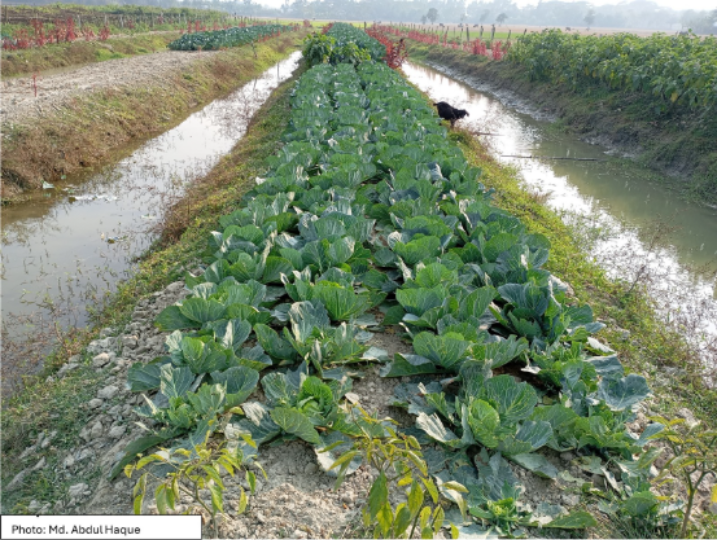
Recognizing its potential, Tania decided to apply the sorjan system on her 0.2 hectare plot of land. Previously, the land was used mainly for rice cultivation, producing about 1.5 tons of rice annually and generating roughly 30,000 Bangladeshi Taka (240 USD) in income. Frequent salinity and waterlogging often reduce yields, making rice farming increasingly unreliable and low-income farming.
“With rice, we worked the entire season, but the return was very small,” Tania explains. “Sometimes the crop was damaged by salt or excess water, so it was difficult to depend on that land.”
Turning a risky rice field into a year-round vegetable farm
Transforming the field required a substantial initial investment of about 250,000 Taka (2000 USD) for land preparation and construction of the raised beds. Despite the high upfront cost, the system soon proved economically viable. The sorjan beds allowed Tania to diversify production and cultivate vegetables throughout two cropping seasons.
During the Rabi (dry) season, she grows tomato, chili, bean, brinjal, cucumber, radish, cabbage, cauliflower, spinach, and bottle gourd. In the Kharif (rainy) season, she cultivates bitter gourd, ash gourd, bottle gourd, sweet gourd, snake gourd, yardlong bean, and other vegetables. This diversified cropping pattern ensures continuous production and reduces dependence on a single crop.
“The advantage of sorjan farming is that the land does not remain idle,” she says. “Even when water stays in the field, the crops on the raised beds continue to grow.”
Managing the system requires regular labor and careful crop management. Tania oversees the entire production process, including bed preparation, seed sowing, fertilizer application, irrigation, pest management, weeding, and harvesting. Weeding is carried out every 20–25 days, while soil fertility is maintained using a combination of market-purchased chemical fertilizers and organic fertilizers such as dry cow dung and vermicompost. Irrigation water comes from her own pond and nearby canals, enabling crop cultivation even during dry periods.
Although the raised beds remain stable for several years, they typically require maintenance every two years, depending on rainfall and soil conditions. Despite this, the system has significantly improved the productivity of the land.
From fragile rice income to stable earnings
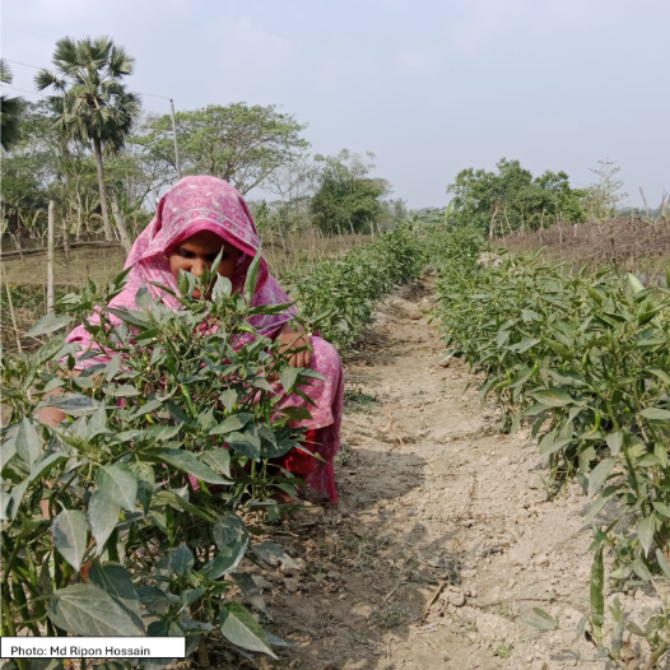
Today, Tania nets approximately BDT 150,000 (about 1,200 USD) annually from vegetable sales from her 0.2 ha farm plot, about five times more than the income from rice cultivation on the same plot. The earnings support household expenses, livestock investments such as cows and goats, and occasional land purchases, strengthening her family’s financial stability. Moreover, the year-round production of different vegetables enhanced dietary diversity and nutrition of the family. More income earnings boosted Tania’s confidence and empowered her to become an agri-entreprenur.
Her farming success has also been supported by ongoing access to extension services. After the initial training from BARI, Tania now receives guidance from field supervisors associated with the International Rice Research Institute (IRRI). Through these interactions she gains access to training, improved seeds, and technical information, enabling her to refine cultivation practices and manage climate-related challenges more effectively.
“When we face difficulties in the field, we can discuss them with the extension officers,” she notes. “They help us with advice on seeds, fertilizers, and crop management.”
Redefining what women farmers can do
Beyond economic benefits, Tania’s work carries broader social significance. In a context where women’s participation in visible farming activities is often constrained, her success has begun to reshape perceptions about women’s capabilities in agriculture.
Initially, some villagers questioned whether a woman could manage such a farming system independently. However, as the sorjan farm began producing consistent results, attitudes gradually shifted. Today, neighboring women farmers frequently visit her field to observe the raised beds and learn about vegetable cultivation. Through informal discussions and hands-on demonstrations, Tania shares her experiences and encourages other women to explore similar opportunities.
“Many women come to see the field and ask how they can start this type of farming,” she says. “I tell them that if we learn and work together, women can also succeed.”
Through this peer learning process, Tania has become a local role model, inspiring three more women farmers to start sorjan farming and forge a pathway to entrepreneurship and economic independence. This story shows how nature-based solutions can improve climate resilience, women empowerment, and livelihoods agriculture.
Tania’s story highlights the powerful intersection of traditional knowledge, climate adaptation, and women’s empowerment. By adopting a nature-based farming system and accessing extension support, she has transformed a climate-vulnerable plot of land into a productive and resilient agricultural enterprise.
Dr. Mou Rani Sarker is an Assistant Scientist-Gender Research at the International Rice Research Institute (IRRI), based in Dhaka. She is a socio-economist specializing in gender and labor dynamics in agri-food systems. Her current research focuses on GESI, climate change, locally-led adaptation, and water governance.
Dr. Humnath Bhandari is the Country Representative for Bangladesh and Nepal. His research focuses on agriculture, food systems, and rural development with special focus on research-for-development in agriculture development, rural livelihoods, food and nutrition security, natural resources management, climate change, agribusiness and markets, agri-food value chains, gender and youth, rural institutions, agricultural policies, and public-private partnerships.