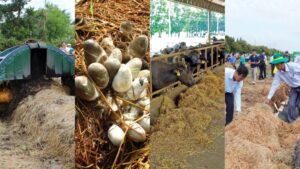
- Stubble burning in India is declining overall (−46% since 2022), driven by major reductions in Punjab and Haryana, but rising sharply in Uttar Pradesh, Rajasthan, and Madhya Pradesh, signaling uneven progress.
- Policy support, subsidies for mechanization, and alternative uses of straw are key drivers of reduction and emerging circular economy opportunities.
- Persistent barriers, such as limited access to technology, weak enforcement, behavioral habits, and underdeveloped markets for residue, must be addressed to achieve zero stubble burning.
By Glenn Concepcion
For decades, the arrival of the winter season in Northern India has been synonymous with a thick, acrid blanket of smog. This environmental crisis, largely fueled by the open-field burning of crop residue, has posed a perennial threat to public health and air quality. However, a new report titled “Towards zero stubble burning: Lessons from Punjab and Haryana and the challenges beyond” from International Rice Research Institute (IRRI) scientists Dilwar Singh Parihar and Suryakanta Khandai reveals a significant shift in the agricultural landscape. While the battle is far from won, recent data suggests that a combination of aggressive policy, multi-million dollar subsidies, and technological innovation is finally beginning to clear the air.
Building on successes
According to the Consortium for Research on Agroecosystem Monitoring and Modeling from Space (CREAMS) Laboratory at the Indian Agricultural Research Institute (IARI), total stubble burning events across six key states—Punjab, Haryana, Madhya Pradesh, Uttar Pradesh, Rajasthan, and Delhi—have plummeted by 46% over the last three years. In 2022, monitoring stations recorded 69,615 burning events; by 2024, that number had dropped to 37,602.
The most dramatic success story comes from Punjab, previously the primary contributor to residue smoke. The state witnessed a staggering 78% decline in burning incidents, falling from nearly 50,000 cases in 2022 to just over 10,000 in 2024. Haryana followed a similar trajectory, achieving a 62% reduction in the same period. This progress indicates that the “Punjab-Haryana model” of intervention is yielding tangible results.
Understanding the challenges
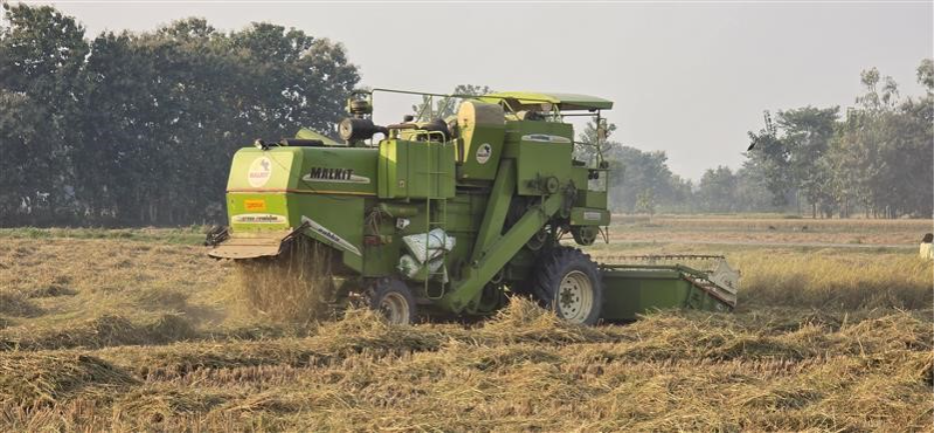
To understand the solution, one must first understand the root of the problem. The widespread adoption of combine harvesters revolutionized rice farming by efficiently cutting and threshing grain, but it left behind massive quantities of paddy residue spread across fields. For farmers racing to sow wheat in the same soil, this residue is a physical barrier that interferes with seed drills.
While burning is ecologically devastating, it has long been perceived as the most “economically convenient” option. Manual removal of residue can cost between ₹6,000 and ₹7,000 per acre, whereas a matchstick costs virtually nothing. Approximately 90 to 140 million tonnes of crop biomass are burnt annually across India because farmers view it as the fastest way to prepare a clean seedbed while potentially reducing pest infestations.
In-situ management: making it work for farmers
The primary driver of the decline in Punjab and Haryana has been a massive push toward in-situ (in-field) residue management. The Indian government and state authorities have invested over ₹1,500 crore ($180 million) to subsidize more than 100,000 Crop Residue Management (CRM) machines.
Innovations such as the Happy Seeder, Super Seeder, and Smart Seeder allow farmers to sow wheat directly into the standing stubble. These machines do more than just avoid fire; they enhance soil health by retaining organic matter, improving moisture retention, and reducing the need for chemical fertilizers. By integrating 92% of the paddy area’s stubble back into the soil in some regions, farmers are transitioning toward a more sustainable, “climate-smart” system.
Ex-situ innovations: The emerging circular economy
Beyond the field, a “circular economy” is emerging that treats paddy straw as a valuable raw material rather than waste. Ex-situ management involves collecting the straw for industrial use, supported by government subsidies of up to 80% for Custom Hiring Centers that rent out baling equipment.
The report highlights several transformative applications for this biomass:
- Bioenergy: Paddy straw can be converted into bioethanol with a 69% concentration or processed into pellets for co-firing in thermal power plants.
- Agriculture: It serves as an ideal substrate for mushroom cultivation, providing farmers with an additional income stream.
- Industry: The paper industry is increasingly using straw for pulp production, which helps reduce deforestation.
- Composting: The “Pusa decomposer,” a bio-chemical solution, can break down straw into nutrient-rich compost in just 20 to 25 days.
Areas of concern
Despite the successes in the northwest, the report sounds an alarm regarding “uneven progress”. As burning declines in Punjab, it is rising sharply in other states. Uttar Pradesh saw a 104% increase in burning events over three years, while Rajasthan and Madhya Pradesh recorded increases of 119% and 39%, respectively.
Even in Delhi, which maintains the lowest overall numbers, incidents increased from 5 cases in 2023 to 13 in 2024. These rising trends suggest that as one region solves the crisis, the practice is migrating to areas where enforcement is weaker and technology is less accessible.
Barriers to progress
Achieving a total ban on stubble burning remains difficult due to several persistent barriers. Behavioral habits and cultural norms are deeply ingrained, and many small-scale farmers still lack access to expensive CRM machinery despite subsidies.
Furthermore, the report notes that awareness campaigns often arrive too late, frequently at the end of the season when farmers are already focused on harvesting and marketing. There is also a lack of stable market demand and fair pricing for collected residue, which discourages farmers from investing the effort to collect and sell their straw.
Looking to the future
The path forward requires more than just machines; it requires a shift toward a market-driven approach. For long-term sustainability, the report suggests expanding ex-situ applications and ensuring that residue management is integrated into early-stage agricultural planning rather than treated as a last-minute crisis.
The sharp decline in Punjab and Haryana proves that the vision of a stubble-burning-free India is possible. However, the rising smoke in neighboring states serves as a reminder that the strategy must be scaled nationally, with stronger policy coordination and proactive measures to ensure no farmer is left behind in the green transition.
Read the report:
Dilwar Singh Parihar, Suryakanta Khandai
Towards zero stubble burning: Lessons from Punjab and Haryana and the challenges beyond
International Rice Research Institute, Los Baños, Philippines. 7 p.
https://cgspace.cgiar.org/items/37af4f11-f61f-4211-82b2-0a268d8822ac