By Shalini Gakhar, Preeti Bharti, and Manas Ranjan Sahoo
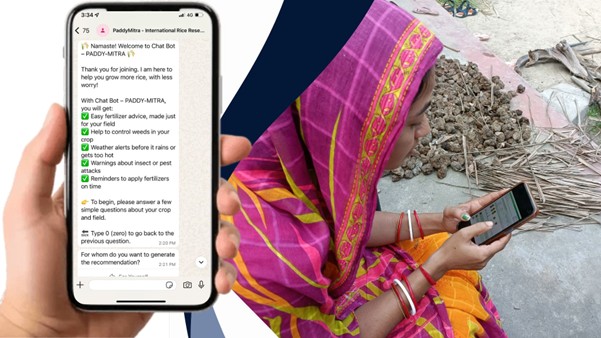
When a farmer in rural Odisha, India, receives an alert on WhatsApp at dawn and acts on it before the crop is lost, that is not technology. That is a revolution in slow motion.
The next agricultural extension officer may not ride a motorcycle to the field, he/she may arrive silently on the phone. The scientific knowledge and data no longer sit in the labs and research stations, but are being diffused in simple, understandable, and actionable form to the rural farmers through a multitude of digital communication platforms.
As per Odisha’s Economic Survey 2025-26, 85.90% of the rural population owns a mobile phone. Across villages, the smartphone has quietly become the new field guide, and for millions of smallholder farmers, it may hold the answer to what to plant, when to spray, whether the rain will come in time, and additionally provide specific information on suitable crop varieties, planting time, input use, insect-pest and disease control and weather-based crop management practices.
For years, the International Rice Research Institute (IRRI) has been transforming rice farming in Odisha, introducing stress-tolerant rice varieties (STRVs), climate-resilient varieties, optimised nutrient management, and satellite-based tools that have lifted yields while lowering the farm’s carbon footprint.
Site-Specific Nutrient Management (SSNM): Precision nutrition for every plot
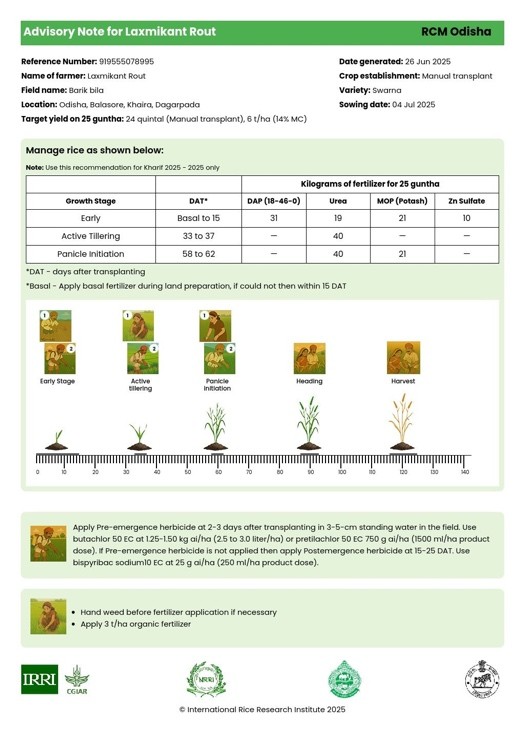
Site-Specific Nutrient Management (SSNM) is one such climate-smart technology to guide farmers on balanced and timely application of fertilizers in their rice fields. Using the SSNM approach, a web-based tool Rice Crop Manager (RCM) for Odisha was developed in 2015 to guide farmers on the four R’s of nutrient application: Right Source, Right Rate, Right Time, and Right Place. Results from farmers’ fields who have followed RCM advisories have shown an increased yield gain by 17-19% compared to traditional Farmer Fertilizer Practices (FFP).
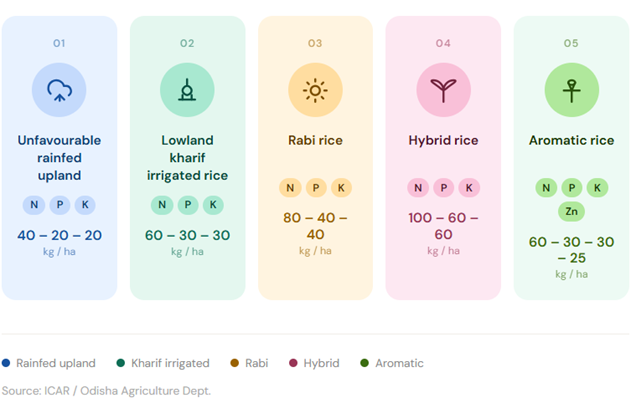
The figure above shows the recommended state fertilizer recommendations under different ecological conditions, irrigation availability, cropping season, and rice varieties. However, farmers in Odisha generally follow the blanket fertilizer recommendation (80:40:40 kg NPK/ha) which does not account for spatial variability in soil fertility and crop requirements. SSNM customises nutrient application based on field-specific conditions such as soil properties, varietal duration, crop management practices, and previous yield, resulting in improved yields and reduced environmental impact compared to traditional blanket fertilizer applications.
What if decades of rice science could fit in a farmer’s pocket and speak to them in their own language?
Rice Crop Manager, IRRI’s field-tested nutrient management platform built over years of Odisha-specific agronomic research, has become the scientific backbone of the far more ambitious PaddyMitra, or Precision Advisory for Data-Driven Yield, Management of Irrigation, Timing and Resource Application.
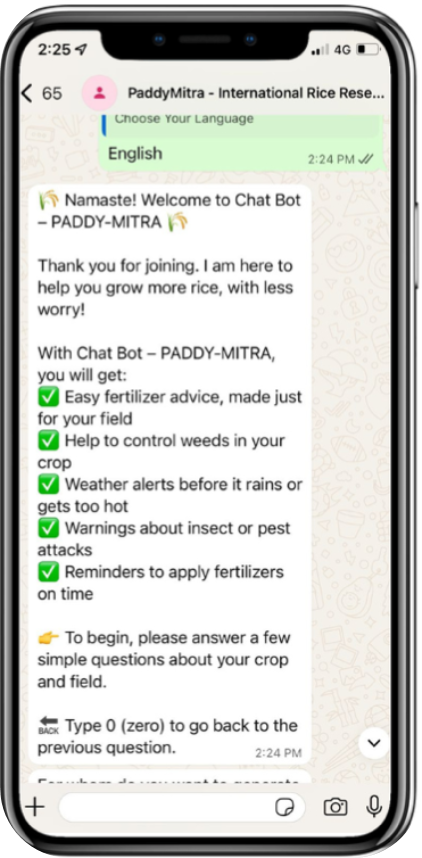
Before building the chatbot, IRRI’s team applied machine learning algorithms over RCM’s accumulated field data to pinpoint which parameters such as, soil type, crop variety, growth stage, and agro-climatic zone matter most in determining the right NPK dose for a given farmer, on a given field, in a given season. The result was a smarter, leaner advisory engine, precise without being complicated.
The delivery channel chose itself. A farmer survey across Odisha revealed WhatsApp as the runaway favourite for digital communication. So in September 2025, IRRI launched PaddyMitra directly on WhatsApp. Farmers now receive instant, localised fertiliser, weather, and weed management advice in Odisha through a simple text or voice message.
Yield gains over farmers’ practice
PaddyMitra has been piloted during Kharif (wet season) 2025 among ~1500 farmers and has already reached 7500 farmers in Odisha. The farmers who received recommendations were studied throughout the season to assess the use of advisories and yield gains over farmers’ fertilizer practice, while keeping the rest of the crop management the same in both treatments.
The district-wise comparison of rice yield showed a consistent advantage of the PaddyMitra advisories over the Farmers’ Fertilizer Practice (FFP) across all study locations in the three selected districts: Puri, Ganjam, and Balasore.
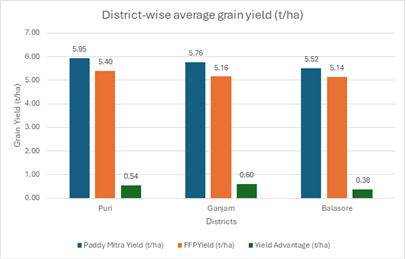
In Puri, PaddyMitra recorded a grain yield of 5.95 t ha⁻¹, which was higher than FFP (5.40 t ha⁻¹), resulting in a yield advantage of 0.54 t ha⁻¹ (10.0% increase). Similarly, in Ganjam, the yield under PaddyMitra (5.76 t ha⁻¹) exceeded that of FFP (5.16 t ha⁻¹), with the highest yield gain of 0.60 t ha⁻¹ (11.6%). In Balasore, PaddyMitra produced 5.52 t ha⁻¹, compared to 5.14 t ha⁻¹ under FFP, giving a yield advantage of 0.38 t ha⁻¹ (7.4%).
Overall, the PaddyMitra practice resulted in a yield improvement ranging from 0.38 to 0.60 t ha⁻¹, corresponding to an increase of approximately 7–12% over the existing farmers’ practice. The highest response observed in Ganjam can be attributed to higher difference in the NPK (Nitrogen, Phosphorus, Potassium) use and timing of application in PaddyMitra and FFP, whereas the relatively lower gain in Balasore suggests less management variability between the two treatments.
Benefit-cost ratio
| Treatment | Cost of cultivation (USD/ha) | Gross return (USD/ha) | Net return (USD/ha) | B:C ratio |
| PaddyMitra | 867.2 | 1428.6 | 561.4 | 1.63 |
| FFP | 862.3 | 1309.8 | 447.5 | 1.51 |
The economic analysis of Kharif 2025 data revealed that PaddyMitra demonstrated superior performance compared to Farmers’ Field Practice. On average, PaddyMitra recorded higher gross returns (USD 1428.6/ha) and net returns (USD 561.4 /ha) than FFP (USD 1309.8/ha and USD 447.5 /ha, respectively). The benefit-cost (B:C) ratio was also higher in PaddyMitra (1.63) compared to FFP (1.51), indicating better profitability and economic efficiency (Table 1). The Minimum Support Price (MSP) for rice is 25.2 dollars per quintal.
What’s next?
The upcoming version, PaddyMitra 2.0 will have AI-enabled advisories on nutrient management, seed suitability, and insect-pest management combined with weather intelligence.
Farmers will be able to converse (type and speak) in regional language and get informed about integrated nutrient management, like the use of organic and bio-fertilizers, identification, cause and remedies for the toxicity and deficiency of various macro and micronutrients. An image-based insect-pest and disease detection model will help farmers identify and seek solutions for insect-pest attacks in their rice fields. The chatbot will guide farmers to select suitable rice varieties for their region based on the climatic stresses experienced in that area. The model is being trained using the decade-long research dataset and will be instrumental in bringing scientific knowledge and actionable solutions to farmers’ fingertips. Weather-based advisories will help farmers take informed decisions and save them from the erratic weather stresses.
Scaling beyond the pilot trap
Despite successful piloting, many digital applications fail to reach scale and adoption due to weak integration of local context and limited convergence between AI, extension, and community. Chances of the farmers rejecting an application are higher if it is technology-driven rather than farmer-centred. One significant step would be benchmarking to quantify how often a model fabricates facts, contradicts itself, or produces confidently wrong answers, a critical safety consideration in high-stakes applications.
To make digital advisory systems effective, solutions must move beyond information delivery toward contextual, accessible, and human-centred support that farmers can trust and use consistently. PaddyMitra aims to fill this gap by providing a simple interface on WhatsApp for low-literacy users. A pluralistic approach involving extension staff of agriculture departments, community members, Farmer Producer Companies, private partners, and Foundations will contribute to scaling PaddyMitra beyond the pilot and benefit farmers at large scale.
Acknowledgement: The work is part of the Digital Transformation Accelerator and Climate Action Science Program. The field trials were conducted by Manas Ranjan Sahoo, Research Technician III and Kshitikanta Rout, Research Technician III.
Note: The analysis was done only for a single season; more data will yield optimised results.
For more information, please contact:
Shalini Gakhar, Data Scientist: Interoperability and Data Science Life Cycle, s.gakhar@cgair.org
Preeti Bharti, Associate Scientist- Agricultural Research and Development