Black Soldier Fly (BSF)-derived organic fertilizers offer a circular and sustainable solution for rice systems by recycling waste into nutrient-rich amendments that improve soil health, suppress pests, and boost plant immunity.
By Archana Mishra and Panneerselvam Peramaiyan
Rice is the staple food for more than half of the world’s population and is central to food and nutritional security, particularly across Asia and Africa. Global rice consumption has increased steadily from approximately 437 million metric tons in 2008-09 to about 539 million metric tons in 2024-25, reflecting growing demand driven by population growth, urbanization, and changing dietary preferences.
India, the world’s largest rice producer and exporter, plays a pivotal role in ensuring global food security while supporting the livelihoods of millions of smallholder farming households. As rice cultivation occupies a substantial share of India’s agricultural land and contributes significantly to greenhouse gas (GHG) emissions, there is a unique opportunity to lead the transition toward climate-smart, low-carbon rice farming.
IRRI and national research systems have strengthened productivity, resource efficiency, and climate resilience with stress tolerant varieties (STRVs), mechanization, precision nutrient and water management, and digital agriculture. This calls for the next phase of transformation to integrate organic and regenerative agriculture, emphasizing low-carbon, nature-based solutions that restore soil health, enhance biodiversity, strengthen biological pest regulation, and improve ecosystem resilience.
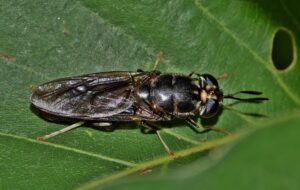
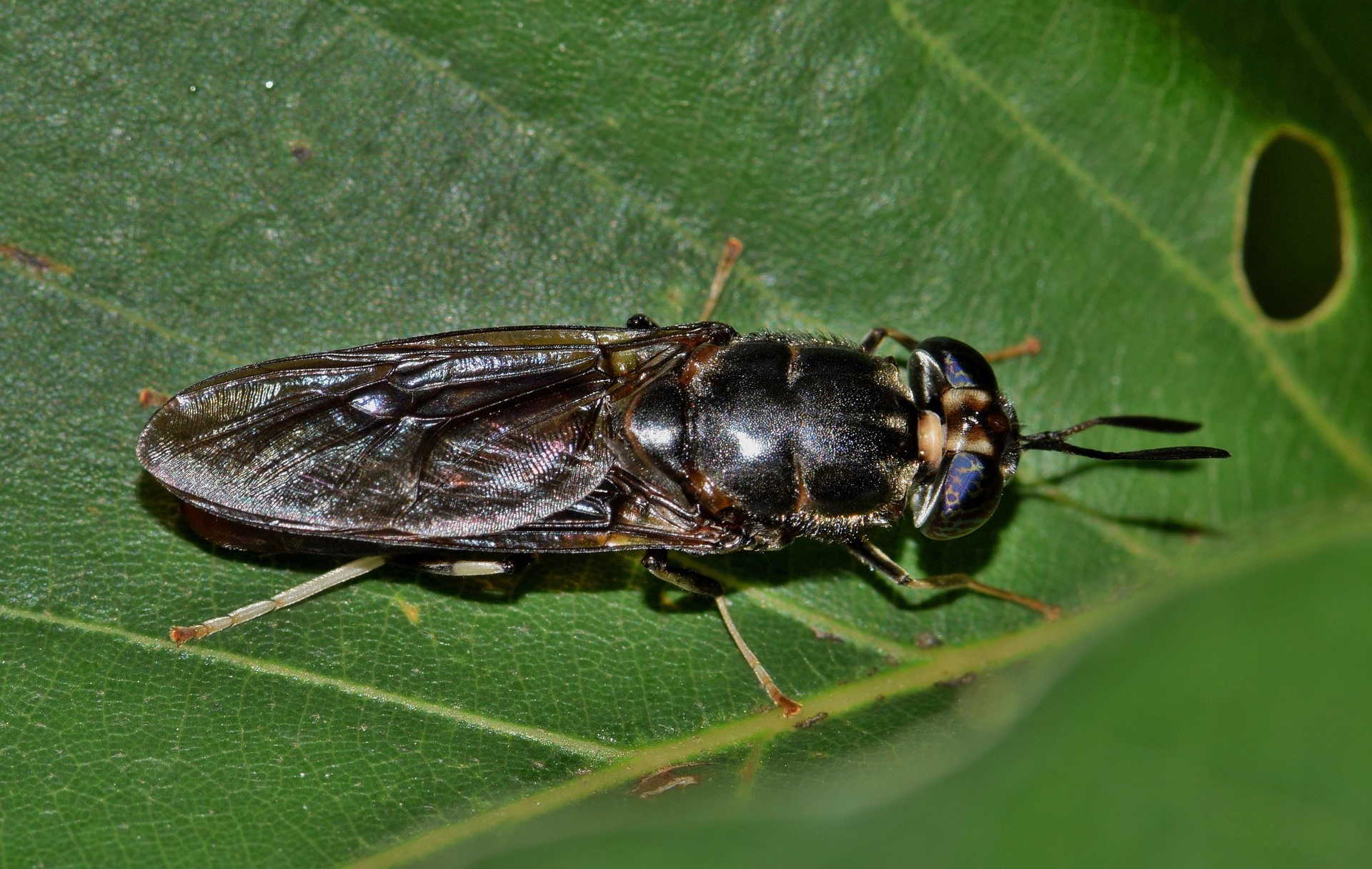
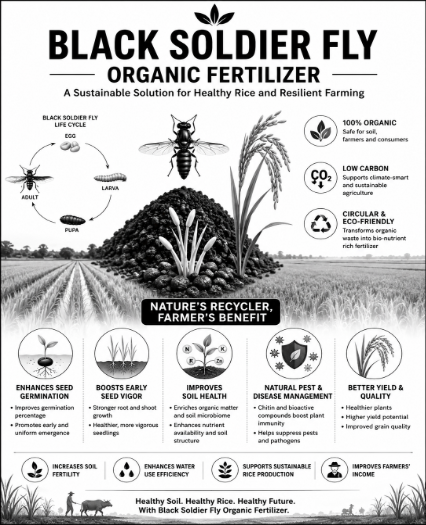
In this direction, Black Soldier Fly (Hermetia illucens, BSF) derived organic fertilizer offer significant potential by converting organic waste into nutrient-rich biofertilizers that improve soil fertility, support beneficial soil microbiomes, suppress soil-borne pests, and contribute to sustainable integrated pest management in rice-based production systems.
BSFF supplies essential nutrients and beneficial microbes, while chitin-rich exoskeletons enhance plant immunity and suppress insect pests, diseases, plant-parasitic nematodes, and reduce dependence on synthetic pesticides. Further, combining BSF-derived chitin with bioactive molecules such as Azadirachta indica (neem), Asafoetida (hing), Curcuma longa (turmeric) may offer a synergistic Integrated pest management (IPM) strategy. Recent studies have demonstrated that BSF frass fertilizer enhances crop productivity, soil health, and ecosystem functioning. Farmer preference studies, including a 2023 Australian survey, demonstrate strong market potential for granular BSF-derived fertilizers, particularly among organic and regenerative farmers, supporting their commercialization and integration into circular bioeconomy model.
In this regard, A greenhouse experiment was established at ISARC to evaluate the performance of BSFF biopriming on the specialty rice “Kalanamak”. Rich in zinc (Zn), low in glycemic index (GI), and prized for its aroma, Kalanamak rice improves consumer health while increasing farmers’ income through premium market value. Despite its premium quality, the rice is constrained by low germination, yield, susceptibility to pests and diseases, and limited adoption of improved cultivation practices.
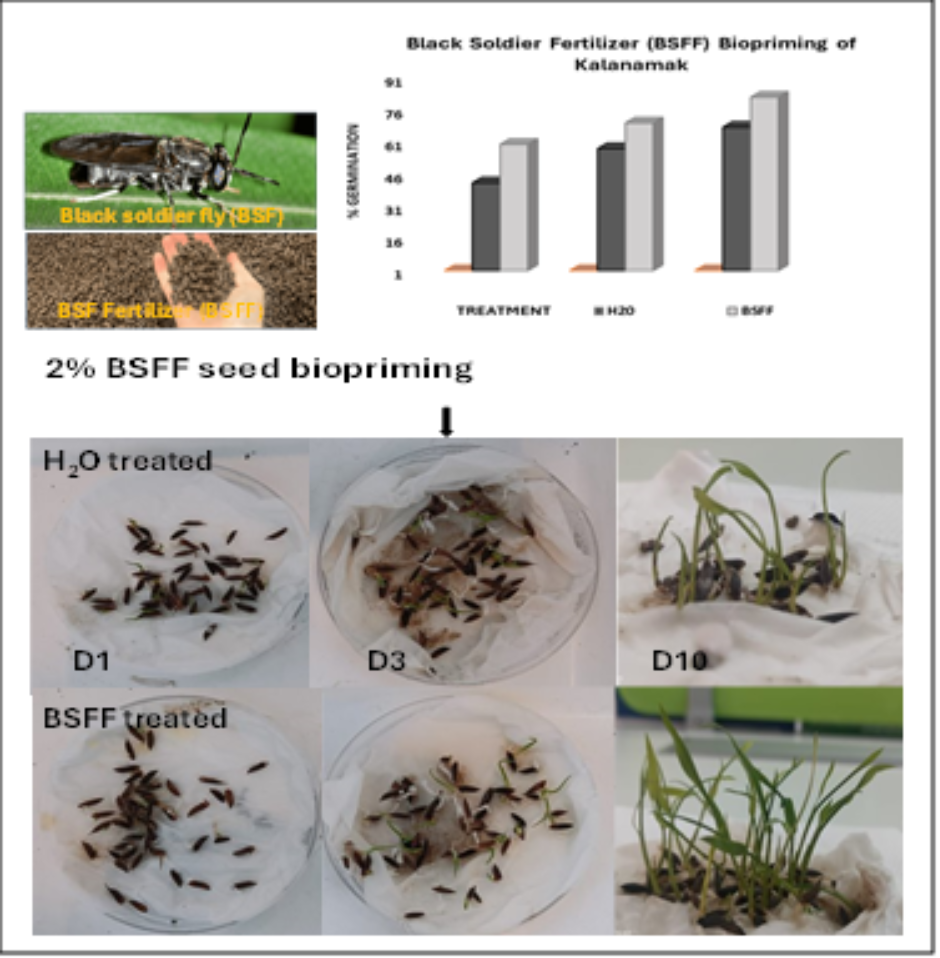
The data represented that BSFF-based seed biopriming (2% BSFF) significantly enhanced Kalanamak germination by 42.85%, 20.68%, and 20.58% on Days 1, 3, and 10, respectively, compared with water-treated controls. BSFF-primed seedlings also exhibited greater vigor, indicating improved early establishment and enhanced potential to withstand disease and pest pressures and climatic constraints (Fig. 1). This finding has strong potential to enhance the production of premium rice by improving both yield and market value, thereby increasing farmers’ income. Furthermore, we presume that in-field, the combined application of BSF-derived organic fertilizer as a soil amendment and seed biopriming might promote rapid and uniform germination, improved early crop vigour. This highlights the potential of BSFF as a sustainable strategy for enhancing rice establishments and supporting environmentally resilient rice production.
As the benefit of BSF is getting recognized, the global BSF industry is experiencing rapid growth with approx.31% annual growth rate, driven by increasing demand for sustainable waste management, circular bioeconomy solutions, and eco-friendly agricultural inputs. BSF bioconversion technology is now being commercialized across Europe, North America, Asia, Africa, and Latin America for producing insect protein, oils, and nutrient-rich organic fertilizers.
Complementing this industrial expansion, market studies indicate strong adoption potential for BSF-derived fertilizers, particularly among farmers practicing organic and regenerative agriculture from developed countries. Farmers’ willingness to pay increases with higher organic carbon and NPK content, highlighting the importance of product quality and market acceptance.
Future research should move beyond the use of BSF products as organic fertilizers and explore integrated biorefinery approaches that maximize the value of all BSF-derived products. In addition to nutrient-rich frass and chitin, BSF larvae are a valuable source of lipids whose biodegradable oils could serve as eco-friendly carriers or adjuvants for botanical pesticides and biofertilizers. Such formulations may improve the controlled release, stability, and efficacy of bioactive compounds while enhancing soil fertility and reducing dependence on synthetic agrochemicals.
Developing multifunctional BSF-based biofertilizer–biopesticide formulations have the potential to transform integrated pest management, restore soil health, and accelerate the transition toward regenerative, low-carbon, and circular agricultural systems. Looking forward, the next generation of BSF farming must integrate science, policy, and technology with digi-innovations to ensure resilient, traceable, and ethically managed systems that may align with major organic agriculture principles.
Dr. Archana Mishra is a Plant Pathologist at the IRRI South Asia Regional Centre (ISARC), Varanasi. She holds a Ph.D. in Entomology from Banaras Hindu University and brings over 20 years of national and international research experience in molecular entomology, plant pathology, biological control, plant defense mechanisms, and sustainable crop protection for resilient agricultural systems.
Dr. Panneerselvam Peramaiyan is a Scientist II-Cropping Systems Agronomy at IRRI, leading research on Direct-Seeded Rice (DSR) and climate-smart agronomy to improve productivity, nutrient-use efficiency, and sustainability. With extensive national and international research experience, he drives evidence-based innovations that strengthen rice-based cropping systems and support smallholder farmers across South Asia.