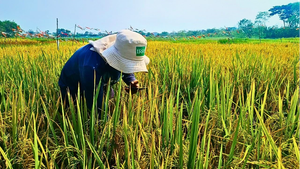
- Dr. Peter Jennings, IRRI’s first rice breeder, led the development of IR8, the variety that helped launch the Green Revolution in Asia.
- His pioneering work on semidwarf rice transformed global rice breeding and later reshaped rice production in Latin America.
- His legacy continues through the improved rice varieties, breeding programs, and scientists his work inspired.
By Myrtel Anne G. Valenzuela, with editorial contributions from Gene Hettel
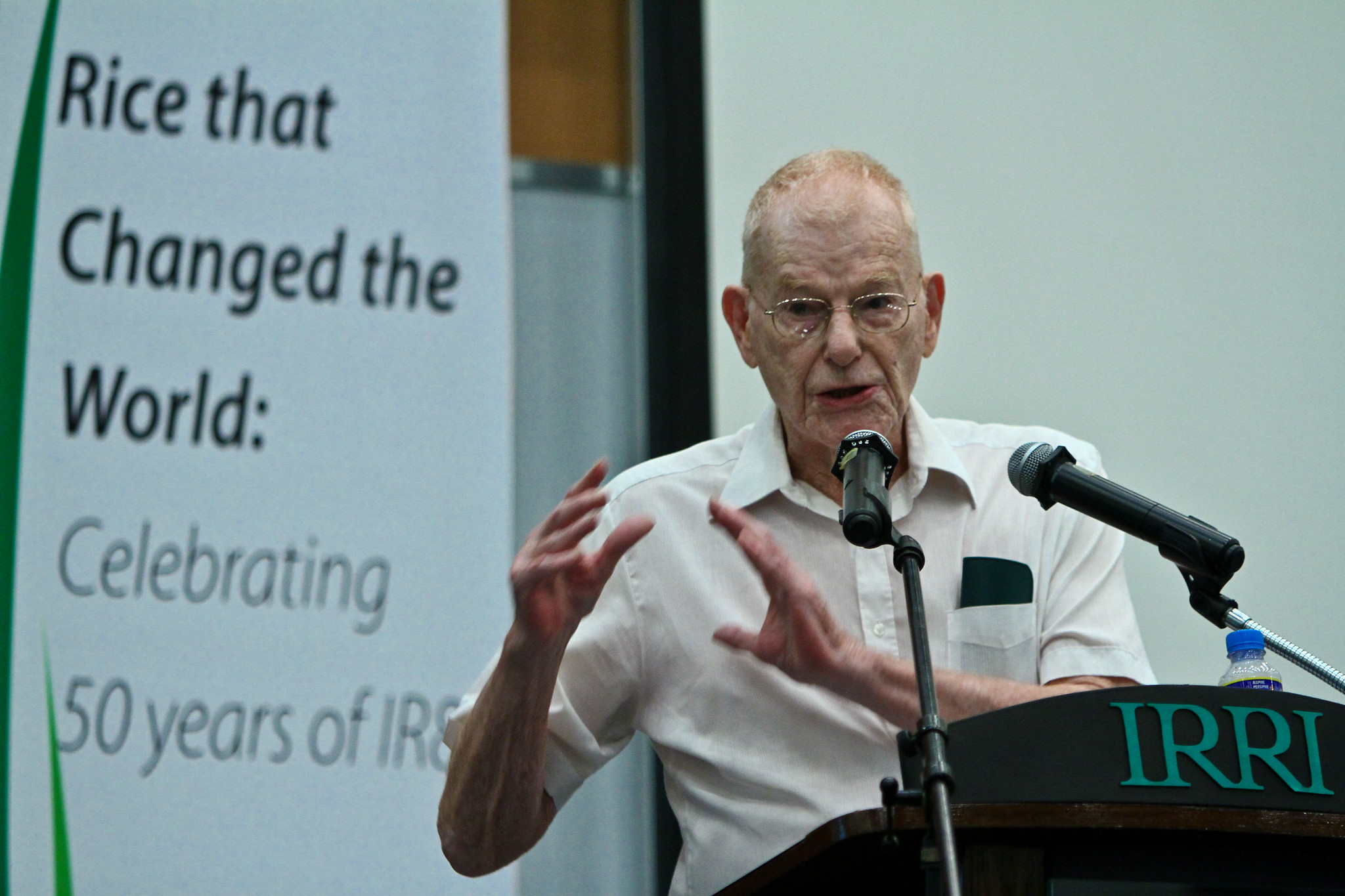
Peter Randolph Jennings, 95, the first rice breeder at the International Rice Research Institute (IRRI), passed away in Raleigh, North Carolina, USA, on 20 June 2026.
Few scientists have transformed global agriculture as profoundly as Dr. Jennings. During his six years at IRRI (1961–1967), he led the development of IR8, the world’s first high-yielding semidwarf rice variety that jump-started the Green Revolution in Asia and laid the foundation for modern rice breeding.
Jennings confronted one of the greatest agricultural challenges of the twentieth century: feeding a rapidly growing population in the developing world. He believed the solution was not simply to cultivate more land, but to redesign the rice plant itself. The result was IR8, the variety that enabled farmers to harvest significantly larger crops and transformed rice production across Asia.
Jennings’ impact extended far beyond IRRI. After leaving the institute, he introduced the semidwarf breeding approach developed in Asia to Latin America, helping transform rice production across the region. He also championed the integration of plant breeding and agronomic research, recognizing that improved varieties achieve their greatest impact when combined with sound crop management. Over the next 35 years, he became a foundational figure in Latin American agricultural research, collaborating extensively with CIAT, FEDEARROZ, and FLAR in Colombia.
A lifetime dedicated to rice
Jennings earned his doctorate in plant pathology from Purdue University in 1957 and then joined the Rockefeller Foundation where he first worked as a plant pathologist in Mexico for a while but mostly in Colombia.

At the behest of IRRI’s first Director General Robert Chandler, Jennings made a study tour of rice fields across Asia in 1960 during which time he became convinced that the greatest opportunities for improving rice production would be in that region. With that, he joined IRRI in 1961 as the institute’s first rice breeder and the first head of its Plant Breeding Department, embarking on the work that would ultimately define his career.
Rethinking the rice plant
In the early 1960s, rice farmers in Asia faced a frustrating problem. Traditional rice plants grew tall with long, weak stems. Fertilizer helped produce more grain, but it also made the plants heavier, causing many to topple over before harvesting. The result was lower yields and lost income.
“We determined that, if we were going to make any progress, we had to dramatically change the plant type,” he said during his IRRI Pioneer Interview conducted by IRRI historian Gene Hettel.

Working with his team at IRRI, Jennings crossed Peta, a tall rice variety from Indonesia, with Dee-geo-woo-gen (DGWG), a naturally dwarf variety from Taiwan. The first generation of plants (F1), however, was discouraging. Instead of becoming shorter, they grew even taller than their parents, reaching 6 to 7 feet in height.
Rather than abandoning the project, the team planted thousands of second-generation plants (F2), believing that the right combination of traits would eventually emerge.
A once-in-a-lifetime discovery
About a month after transplanting, Jennings and his colleagues walked through the experimental fields.
Most of the plots were filled with towering rice plants. Then they reached one population that involved the Taiwanese dwarf variety. Among the sea of tall plants, a small group of shorter ones caught their attention. They were dark green, sturdy, and upright, with an unusually large number of tillers, the shoots that later develop into grain-bearing stems.
Jennings knew immediately that he was looking at something extraordinary. “It was an epiphany! I never had an experience like that in my life, before or since,” he exclaimed during his Pioneer Interview.
Further study confirmed what Jennings had recognized in the field. The shorter stature was controlled by a single inherited “semidwarf” gene, allowing breeders to reliably develop shorter, sturdier rice plants that could support heavier grains without falling over. It was the breakthrough the team had been searching for.
The birth of “Miracle Rice”

The breakthrough led to the development of IR8, released in 1966 as IRRI’s first rice variety. Just six years after IRRI’s founding, and from only the eighth of 38 crosses made by the breeding team, the institute had produced a variety that would transform global rice production.
Nicknamed by the Philippine media as the “Miracle Rice,” IR8 produced harvests far greater than traditional varieties under good growing conditions. It spread rapidly across Asia during the 1960s and 1970s, helping countries dramatically increase rice production at a time when many feared widespread famine.
In the Philippines, where farmers typically harvested about 1.2 metric tons of rice per hectare before IR8, the new variety consistently produced 5 to 10 metric tons per hectare under favorable conditions, demonstrating the dramatic gains made possible through improved plant breeding.

Beyond its immediate impact, IR8 became the foundation of modern rice breeding. Nearly every new and improved high-yielding rice variety developed over subsequent decades can trace part of its parentage to IR8.
A legacy that endures

Jennings often reflected on the development of IR8 with characteristic humility. Looking back, he credited its success not only to careful science and persistence, but also to the unpredictable nature of discovery.
“There is always luck. But sometimes, you earn your luck. You influence your luck for sure.”
His words reflected the philosophy that guided his career. Breakthroughs, he believed, were rarely the result of chance alone. They came from years of asking difficult questions, testing bold ideas, and persevering when the answers were not immediately clear.
His work reshaped global agriculture. It transformed rice production, laid the foundation for modern rice breeding, and strengthened food security for billions of people through the combination of genetic improvement and agronomic research.
Robert Zeigler, former IRRI Director General, who worked with Jennings in Latin America during the 1980s, recalled: “It was very interesting to begin my work on rice in Latin America with Peter Jennings in the 1980s. By then, the Green Revolution had really run its course dramatically, and Peter had a lot to do with it, driving it through. He was really the father of the Green Revolution in rice, but was never properly recognized, in my opinion. I always respected his intellect, which was quite keen, and even his quirky personality.”
Luis Sanint, former Director of FLAR, described Jennings as “a legend in the rice world,” adding: “Peter left a tremendous legacy to humanity; for those of us who knew him and were fortunate enough to work with him, he set an example of excellence and pragmatism, demonstrating that one can serve science while achieving monumental impacts that benefit producers, consumers, and society as a whole.”
Jennings never sought recognition for his achievements. His legacy lives on in the rice varieties grown around the world, the breeding programs he helped shape, and the millions of farmers and consumers whose lives have been improved through his work.
References:
Changing the world with seeds: The breeding history of IR8. (2020). Rice Today
Green Revolution: IRRI innovations (2021). IRRI Exposure
IR8—a rice variety for the ages. (2016). Rice Today
The brains and brawn behind IR8. (2016). Rice Today
The IRRI Pioneer Interviews. (2008) International Rice Research Institute. (See the feature on the Jennings interview on pages 1-2.)
Mackill, David J. (2018). Special issue: Iconic rice varieties. Rice, 11(1), 16.
Jennning’s IRRI Pioneer Interview in two parts (2007). (Part 01) (Part 02)