By Sharif Ahmed, Abdullah Miajy, and Humnath Bhandari

Mechanical rice transplanting in Bangladesh offers significant potential to increase productivity and address labor shortages in rice farming, but its adoption faces challenges due to high costs, technical barriers, inadequate infrastructure, and limited government support.
In Bangladesh, 75% of the land is devoted to year-round rice production. Rice is typically grown using manually transplanted seedlings placed into puddled soil, although a small portion is also direct-seeded. Agricultural labor is declining sharply in Bangladesh, leading to high demand for workers during the peak transplanting period. Farmers typically do not have a wide window for transplanting due to various environmental factors and issues related to crop intensification. As a result of the high demand and labor shortages during this crucial time, labor prices often rise above normal levels. These increased transplanting costs significantly impact farmers’ overall profit margins. Additionally, delaying the transplanting process can adversely affect crop yields.
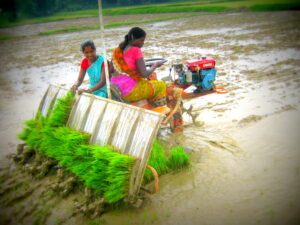
Mechanical rice transplanting holds significant importance for Bangladesh due to its potential to transform the country’s rice production system (from conventional to mechanized). A rice transplanter is a mechanical device used to transplant rice seedlings from a tray or a nursery mat into a paddy field. Instead of manual planting (a very time-consuming and labor-intensive process), rice transplanter automates the task, ensuring even spacing and depth for optimal plant growth.
Importance of mechanical rice transplanting in Bangladesh
- The country relies heavily on timely and high-yielding rice production to ensure food security. Mechanical rice transplanting can accelerate the transplantation process, allowing farmers to plant rice more quickly and uniformly. This timely planting is critical for avoiding weather-related risks, optimizing growing conditions, and increasing overall yields.
- Mechanization in rice transplanting addresses the perennial labor shortages faced by Bangladeshi farmers. With declining rural labor availability and rising wages, mechanical transplanting offers a practical alternative to reduce dependence on manual labor, thus lowering production costs and mitigating labor shortages during peak planting seasons.
- Mechanical transplanting improves the efficiency and productivity of rice cultivation. Transplanting machines ensure uniform planting depth, spacing, and plant density, which are crucial for maximizing yield potential. Consistent planting results in healthier crops with better weed management and nutrient uptake, ultimately leading to increased productivity.
- Adopting mechanical rice transplanting can contribute to rural economic development. By reducing labor costs and increasing yields, farmers can achieve higher profitability. Mechanization can also generate employment opportunities related to machine operation, maintenance, and repair. Additionally, it can enhance Bangladesh’s overall competitiveness in rice production, facilitating export opportunities and reducing reliance on rice imports.
- Mechanical rice transplanting aligns with Bangladesh’s broader goals of modernizing agriculture and promoting technological advancement.

Photo credit: Bappy Kumar, IRRI
In Bangladesh, the first attempt to introduce rice transplanters was in the late 1990s, when a 6-row manual transplanter developed by the International Rice Research Institute (IRRI) was modified by the Bangladesh Rice Research Institute (BRRI) in 2000. The private sector has started importing mechanical transplanters in Bangladesh from 2009.
Currently, the adoption of mechanical rice transplanters in Bangladesh remains relatively low despite their potential to enhance productivity and reduce labor costs. Several interconnected factors contribute to this slow adoption rate, including economic, technical, social, and infrastructural challenges.
- The high initial cost of transplanters poses a significant barrier for many farmers. These machines are expensive, and smallholder farmers, who constitute the majority of rice producers, often lack access to sufficient credit or financial support to invest in them.
- Technical and operational challenges hamper the widespread adoption of mechanical transplanters. These machines require specific skills for maintenance, operation, and repair, which many farmers may not possess. Without adequate training programs or technical support, farmers may hesitate to adopt unfamiliar machinery. Additionally, the availability of spare parts and skilled technicians is often limited in rural areas, raising concerns about potential machinery breakdowns and maintenance issues.
- Infrastructural limitations significantly hinder efforts to mechanize rice farming in Bangladesh. Many rice fields are small and fragmented, often featuring irregular shapes and waterlogged conditions. Additionally, inadequate roads and transportation infrastructure restrict the movement and availability of machinery in remote areas.
- Policy and institutional support are essential in promoting agricultural mechanization. Although the government offered a big mechanization project, its implementation and effectiveness have often been inconsistent or limited. Inadequate subsidies, misuse of funds, lack of awareness campaigns, and insufficient extension services leave many farmers uninformed about the benefits and operational aspects of transplanters.
- A cost-benefit analysis may not support mechanization unless the benefits, such as increased yields or reduced labor costs, are significant and guaranteed. Without clear evidence of long-term profitability, farmers are likely to continue using traditional methods.
Seedlings production is key to mechanical rice transplanting
Seedling production is essential for mechanical transplanting, as it requires specialized seedlings known as mat seedlings. However, many farmers are not familiar with these seedlings and often view the production process as an added burden. This is especially true for smallholder farmers with limited land, for whom producing these seedlings can be particularly challenging.
There are two common methods for seedling production: the tray method and the polythene method. The tray method is comparatively expensive and needs special types of trays. Both methods, however, require technical expertise. Compared with conventional seedling production, seedlings for mechanical transplanting require a higher level of skill and understanding, which can be difficult for many farmers to achieve.
To address these challenges, a viable solution is to establish community-based seedling production systems or develop a service provision-based business model. Service providers can produce high-quality seedlings and offer transplanting services, which reduces the technical burden on individual farmers. This approach not only improves the quality of seedlings but also makes mechanical transplanting more accessible and manageable for smallholder farmers.

Photo credit: Salim Billah, IRRI
IRRI’s experiences in mechanical rice transplanting in Bangladesh
IRRI Bangladesh has been involved in mechanical rice transplantation since 2011 as part of the Cereal Systems Initiative for South Asia (CSISA) project. With support from the Department of Agricultural Extension (DAE) and the Bangladesh Rice Research Institute (BRRI), as well as from CGIAR’s Mixed Farming Systems (MFS) and Sustainable Farming Program (SFP), IRRI Bangladesh worked with over 40 farmer groups between 2023 and 2025 in three northern districts: Rangpur, Dinajpur, and Nilphamari. Each group comprises 20 to 40 farmers. IRRI provided technical assistance for producing seedlings for mechanical transplanting and developed local service providers (LSPs) to offer transplanting services.
From 2023-2025, IRRI Bangladesh worked with over 1000 farmers and established around 50 community nurseries in both methods (tray and polythene soil mat). We compared the yields of mechanical transplanting with manual transplanting and the yield of seedling production from both methods.

Photo credit: Bappy Kumar, IRRI.
Lessons learnt from IRRI’s mechanical rice transplanting activities
- Seedlings production in the Boro season is comparatively harder than in other seasons due to low temperatures. Production of Boro seedlings for mechanical transplanting requires special care (e.g., polythene cover, nutrient and fungicide sprays, frequent irrigation).
- For Boro seedlings, a polythene soil mat nursery is less risky than the tray method.
- Skilled operators are not available at the local level.
- Farmers don’t have any knowledge of seedling production for mechanical transplanting.
- Seedling trays are not available in the local market.
- In a waterlogged field, the water wave displaced the seedling due to the movement of the transplanter.
Strategies for the promotion of mechanical transplanting
- There is a need to explore and develop a suitable business model for the commercial use of mechanical rice transplanters.
- Government extension agents like the DAE can play a crucial role in the rapid adoption of this technology. Therefore, they require specialized training in seedling production.
- DAE, along with BRRI and IRRI, can establish a network of local service providers through hands-on training programs and by connecting with farmers’ groups.
- DAE, BRRI, and IRRI should organize training programs on rice production using rice transplanters for lead farmers.
- Agriculture-based NGOs and private organizations could offer credit facilities and practical training to entrepreneurs, enabling them to purchase transplanters and support the provision of custom hire services.
- As the government provides subsidies for mechanical rice transplanters, there should be a strong monitoring system in place for importers. This will ensure that only quality machines are imported and that spare parts for repairs are readily available.
Mechanical rice transplanting is crucial for sustainable rice production in Bangladesh, especially given the impending labor shortage. This method not only saves labor but also boosts productivity and fosters agricultural modernization. Now is the perfect time to implement initiatives that promote widespread adoption, supported by appropriate policies and scaling efforts.