Climate change, migration, economic pressures and social inequalities are converging in rice-growing regions. Building resilience requires not just climate-smart technologies, but also transforming the conditions that shape women’s capacity to respond and adapt.
By Ranjitha Puskur
Rice systems are confronting a future in which the next crisis rarely arrives on its own. A delayed monsoon can be followed by a flood. Water scarcity can coincide with rising input costs. Migration can leave fewer people to cultivate the land, while those who remain take on additional responsibilities without necessarily gaining greater control over resources or decisions.
These are not separate challenges. They interact, compound one another and expose deeper inequalities. This is the central insight of the focus of Chapter 2, Solutions for equitable resilience capacity building in times of the polycrisis, which I led in CGIAR’s 2026 GENDER Accelerator Flagship Report.
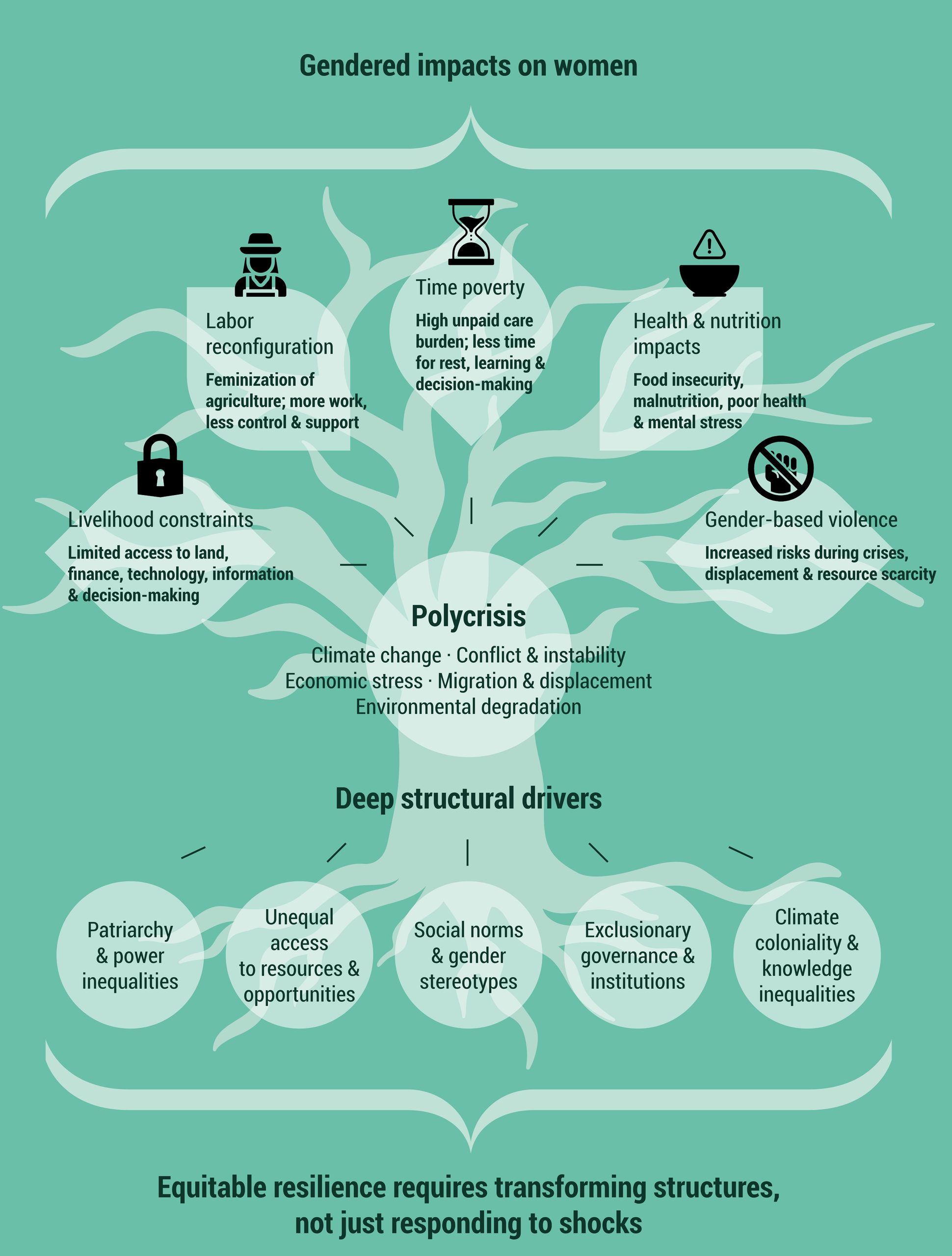
For rice systems, this perspective raises an important question- are we building resilience to individual climate hazards, or are we enabling farming communities to navigate multiple, interconnected crises?
When the risks multiply
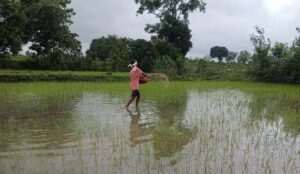
Consider Eastern India’s rice-growing landscapes. Communities in parts of West Bengal have long adapted to flooding and prolonged waterlogging. Yet increasingly uncertain monsoons raise the prospect of drought in places accustomed to excess water. Farmers must contend with risks that are difficult to anticipate, while changing agricultural conditions affect not only harvests but also employment and household incomes.
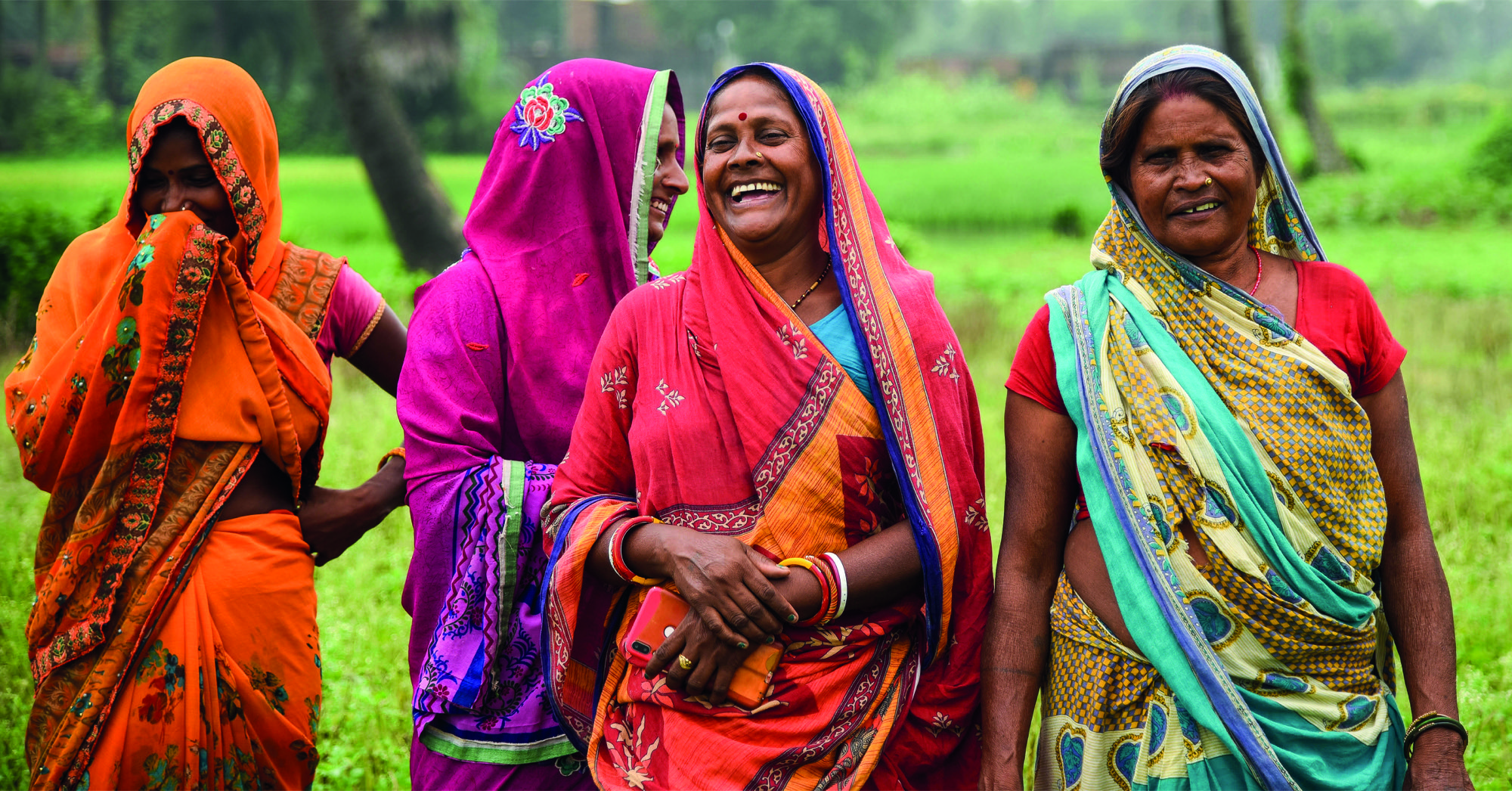
In West Bengal, efforts to prepare women farmers for an uncertain monsoon illustrate why resilience requires more than a forecast. Women need climate information they can access and understand, but also the ability to act on it, discuss options with others and make decisions before losses occur.
Similar pressures unfold across Bangladesh’s delta landscapes, where environmental stress and water insecurity intersect with migration, changing livelihoods and the burden of unpaid care. When men migrate for work, women may assume greater responsibility for farming and household survival. Climate disruptions can also increase the time needed to secure water, fuel and food.
These experiences reveal the wider dynamics of the polycrisis. Climate hazards interact with demographic change, economic insecurity, environmental degradation and existing inequalities. Their effects are not distributed evenly. Women with limited land rights, finance, mobility or access to institutions often have fewer options to prepare for shocks or recover from them. Caste, class, age, disability and migration status can further shape who is most exposed and who can access support.
Resilience is about more than technology
Rice research has made important advances in stress tolerant varieties, water saving practices, digital advisory services and improved crop management. These are necessary, but not sufficient. A technology’s potential does not automatically translate into equitable resilience.
A drought tolerant variety cannot protect a woman farmer who cannot obtain seed at the right time. A climate advisory is of limited use if she cannot access a phone, attend a meeting or influence the decision about when to sow. A water saving practice may remain out of reach if she lacks control over irrigation or the resources to manage the transition.
Even when technologies are adopted, benefits may be accompanied by unintended costs. New practices can increase labour requirements, while climate stress and male outmigration can add to women’s workloads. Without attention to these consequences, interventions intended to strengthen resilience may leave the underlying constraints unchanged.
Evidence from climate-smart agriculture initiatives in India points to the importance of combining technical innovations with social and institutional support. It is not ‘either-or’ with technology and gender equality, but to design them together.
From individual interventions to integrated solutions
Our chapter highlights that no single intervention can build equitable resilience. What matters is how solutions reinforce one another.
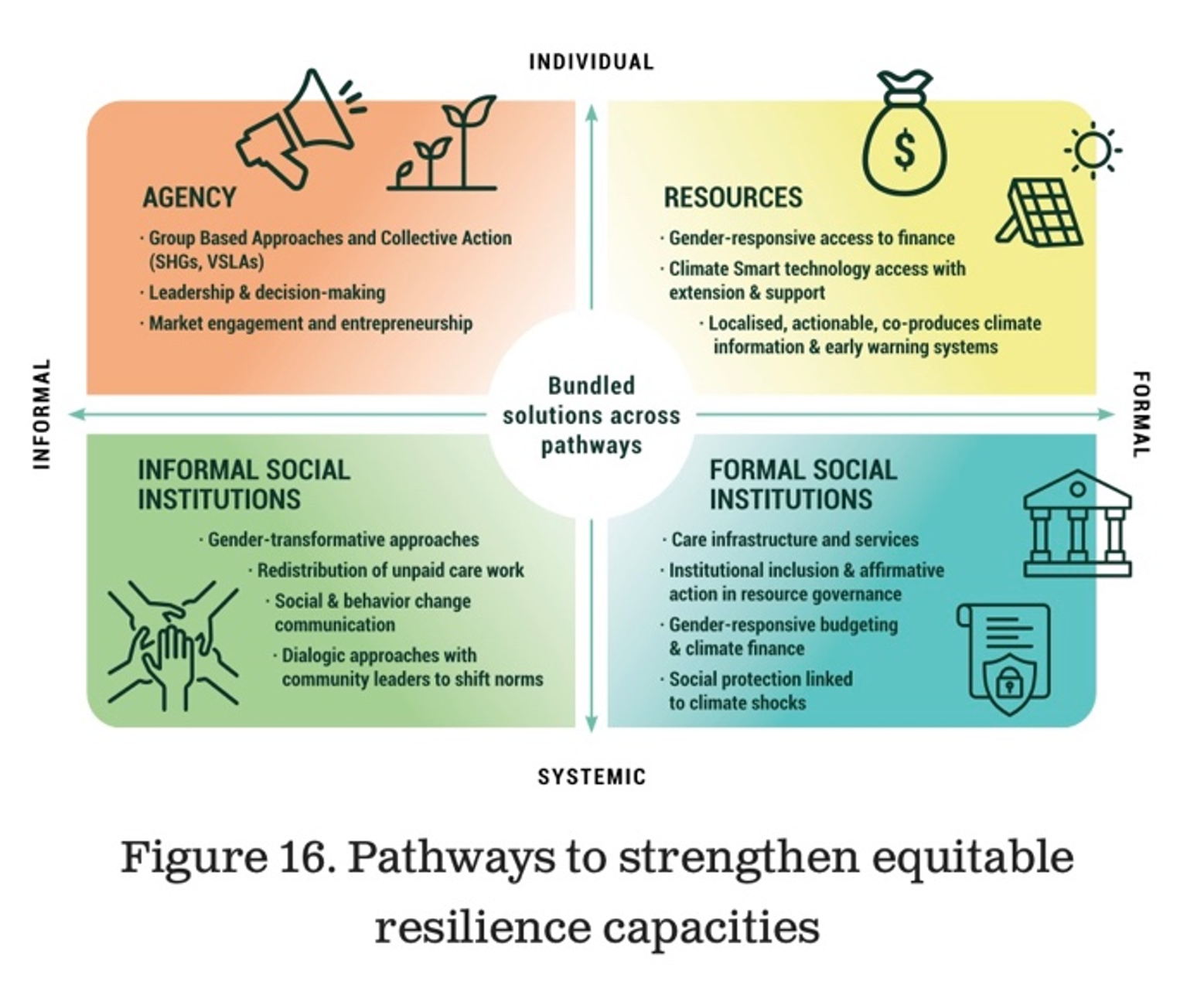
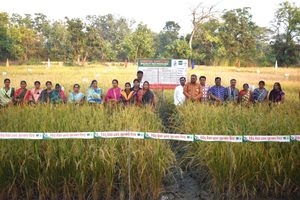
Women’s collectives, for example, can provide platforms for accessing extension, sharing climate information, organising seed procurement and engaging with markets and institutions. Linking these groups to finance and social protection can help households manage risk without sacrificing essential investments or taking on unsustainable debt.
Recognising women as farmers and legitimate users of land and water is equally important. Formal recognition can influence their eligibility for public support, climate finance and agricultural services. Childcare and other care services can reduce time constraints, while institutional arrangements that give women a meaningful voice can help ensure that decisions reflect their priorities.
Solutions must be designed around differences among women rather than treating them as a homogeneous group. A tenant farmer, a landless agricultural worker, a woman managing a farm in the absence of a migrant husband and a young woman seeking an alternative livelihood face different risks and have different capacities to respond.
Changing the conditions for resilience
The implications extend beyond individual projects to the policies and institutions shaping rice systems. Resilience emerges from the interaction between people, resources, institutions and the choices available to them.
Are agricultural programmes recognising women as farmers in their own right? Do extension services reach them in ways that fit their time constraints? Do climate investments address unequal access to land, water and finance? Are women able to influence decisions about technologies, production and resource management? And do monitoring systems capture changes in agency, control over resources and the distribution of benefits, going beyond the number of women reached?
As we look towards 2050, the challenge for rice research and development is twofold: continue developing innovations that help rice systems withstand environmental stress, while transforming the institutional and social conditions that determine who can benefit from them.
Women’s resilience is not simply about helping women cope better with repeated crises. It is about changing the systems that shape their choices, opportunities and power to act. That is what it will take to build rice systems that are not only productive and climate resilient, but also equitable and capable of navigating the polycrisis.
Reference:
Ranjitha Puskur, Aayushi Malhotra, Prama Mukhopadhyay, Anamika Ajay, Evaline Obiero, Isha Sharma, Ananya Chakraborty, Neha Abraham, Padmaja Ravula
Solutions for equitable resilience capacity building in times of the polycrisis
CGIAR Gender Equality and Inclusion Accelerator Report 2026, Chapter 2
https://gender.cgiar.org/2026-gender-report/chapter-2?__goaway_challenge=meta-refresh&__goaway_id=a398c57c065e25a84ef264c0a32be672