What new research reveals about rare genetic variation and how breeders can put it to work
- Researchers found 210 rare genetic variations linked to important rice traits such as yield, grain quality, and stress tolerance.
- One rare variation in the DEP1 gene helped produce longer panicles and up to 9.87% more grain when introduced into the popular Swarna variety.
- The findings show that rare genetic variations already present in known rice diversity could offer new opportunities to improve future rice varieties.
By Ajay Bogati, Reshmi Rani Das & Myrtel Anne Valenzuela
What if some of the most useful genetic variations in rice are hiding in plain sight?
Rice has thousands of varieties, each carrying different versions of genes that influence important traits such as yield, grain quality, plant structure, and the ability to withstand drought, pests, and other stresses.
Breeders have made tremendous progress by using genetic variation that is common and well understood. However, there is another layer of diversity that can be harder to find: rare haplotypes.
A haplotype is a particular combination of genetic variants within a gene or region of the genome. Some haplotypes are common across rice varieties, while others occur in only a small number of varieties. These rare versions may carry useful traits that have received less attention in breeding.
A new study by researchers from IRRI and partner institutions explored this hidden diversity and found that it could offer new opportunities for rice improvement.
A treasure hunt across 1,644 genes
The researchers examined 1,644 well-studied genes linked to important rice traits. They found that around 88% of these genes carried between two and 15 different haplotypes, showing that even genes with known functions can hold considerable genetic diversity.
This diversity, however, was not evenly distributed across rice. Rare haplotypes were especially common in indica and aus rice and less frequent in japonica. Many were also concentrated in particular geographic or genetic groups, suggesting that some rare haplotypes may have developed or been preserved through local adaptation or breeding history.
This pattern helped the researchers narrow their focus to rare haplotypes with potential value for breeding. They identified 210 rare haplotypes across 180 genes linked to traits including yield, grain quality, plant development, responses to pests and diseases, environmental stresses, and hormone pathways.
Identifying these rare haplotypes was an important first step, but their potential could only be confirmed through testing. The researchers therefore selected promising candidates to determine whether these genetic differences could materialize into useful changes in rice plants.
From a rare genetic variant to a better rice plant
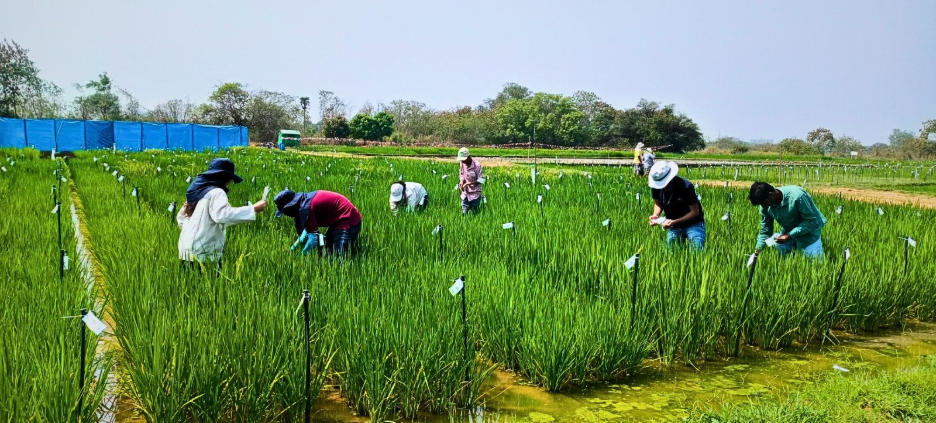
Among the rare haplotypes identified, the team selected a rare variant of the DEP1 gene, called DEP1-H2.
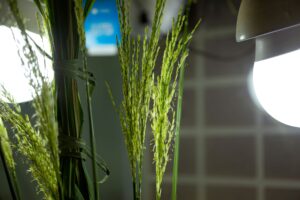
DEP1 is involved in panicle development, which influences the number and arrangement of grains a rice plant can produce. The rare DEP1-H2 haplotype was found in only about 7% of the 3K Rice Genome panel, making it relatively uncommon.
The researchers introduced this rare haplotype into Swarna, a popular elite rice variety, using molecular markers to track the desired genetic variant during breeding.
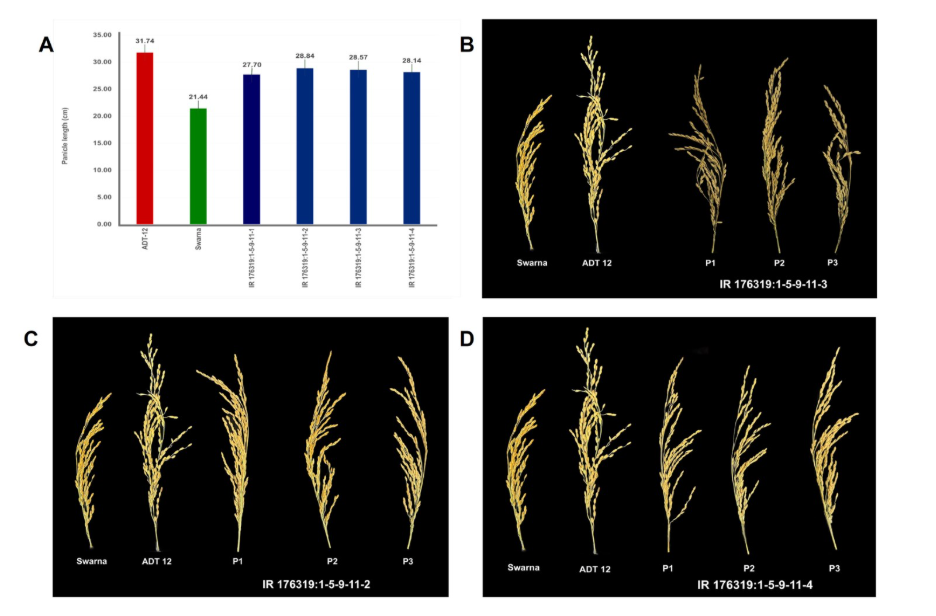
Performance of developed lines for panicle length. (A.) Comparison of panicle length and percentage superiority of introgressed lines over parents. (B.–D.) Phenotypic expression of panicle length in introgressed lines relative to parents.
The resulting lines produced panicles that were 29%–34% longer than Swarna. Under the field conditions tested, the best-performing line also produced up to almost 10% more grains.
This provided experimental evidence that a rare haplotype identified through genome-wide analysis could be put to work as a useful breeding trait.
What does this mean for rice breeding?
The DEP1-H2 example is just one of the 210 rare haplotypes identified in the study.
Other rare haplotypes were linked to grain quality, stress tolerance, plant development, and other traits. These findings open up new possibilities for using rare genetic variation in rice breeding.
The larger opportunity lies in the diversity uncovered across the genome, with rare haplotypes linked to grain quality, stress tolerance, plant development, and other traits that have yet to be fully explored.
The study therefore points to a simple but powerful idea. The next useful source of diversity for rice breeding may not always be a new gene. It may be a rare version of a gene that is already present in the rice diversity we have.
Read the full paper:
Mining rare haplotypes to accelerate precision breeding in rice
By Swati Tyagi, Anoop Kishor Singh Gurjar, Sonali Vijay Habde, Krishna Tesman Sundaram, Namrata Devidas Patil, Diksha Rai, Ajay Bogati, Pronob J. Paul, Ankur Kumar Singh, Ajay Tripathi, Sanjay Kalia, Ajay Kohli, Arvind Kumar, Pallavi Sinha, Uma Maheshwar Singh, Vikas Kumar Singh
The Plant Genome, 2026
DOI: 10.1002/tpg2.70292