The overreaction of rice farmers towards pests and diseases is creating the biggest negative impact on Cambodia’s society.
The Kingdom of Cambodia is proud of its rice, and rightly so. Phka Rumdhuol, a Cambodian aromatic rice, has been crowned the “World’s Best Rice” three years in a row (2012-14) at the Rice Trader’s World Rice Conferences. However, to fully exploit its leading edge in the international market, Cambodia has a number of challenges to tackle.
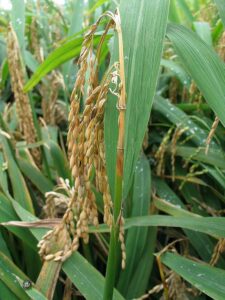
As in other Asian countries, pests, weeds, and diseases are nibbling away the quality and quantity of the country’s rice production.
“But it is the overreaction of farmers towards these yield robbers that can create the biggest negative impact on Cambodia’s society,” said Buyung Hadi, an entomologist at the International Rice Research Institute.
The import value of pesticides in Cambodia has increased dramatically in the last decade or so. Some studies have shown that an increase in the availability of pesticides does not always follow an increased understanding of the proper usage of the products. This may lead to undesirable costs in farmers’ health and livelihood.
“Clearly, something needs to be done,” Dr. Hadi said.
The increased availability and awareness of ecologically-based Integrated Pest Management (eIPM) methods and products were identified as an entry point to improve the situation.
Enter EPIC, a new partnership for rice IPM research and capacity enhancement in Cambodia.
EPIC (Development of ecologically-based, participatory IPM package for rice in Cambodia) is a 4-year project led by the International Rice Research Institute (IRRI) and funded by United States Agency for International Development (USAID) under the Feed the Future Innovation Lab for Integrated Pest Management.
“EPIC enables the validation and packaging of a number of IPM tactics for rice pests, weeds, and diseases in the Cambodian context,” said Dr. Hadi who leads the project that was launched earlier this year.
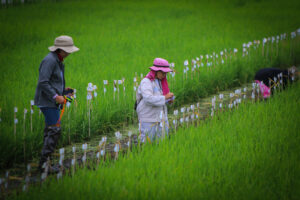
To guide the validation and deployment of different eIPM tactics, EPIC systematically surveys key pests, diseases, and weeds in four target provinces across the country. The last time a systematic survey was done in the country was in early 1990s.
Since the project started, Nancy Castilla, a plant pathologist at IRRI, has been leading training sessions and collaborating with Cambodian Agricultural Research and Development Institute (CARDI) to conduct this systematic field survey. The involvement of virology, bacteriology, weed management, rodent ecology, and entomology teams from IRRI further strengthens this field survey.
At the same time, Rica Flor, an IRRI postdoctoral fellow in Innovation Systems, traveled across Cambodian provinces with a team from General Directorate of Agriculture (GDA) to interview farmers and gather information on their current pest and crop management practices. IRRI collaborators from the Cambodian Center for Study and Development in Agriculture, Virginia Tech, and Cornell University joined the activity to reach broader farming populations.
“The results from these two field works form a rich mosaic of information on pest and diseases situations in Cambodian rice farms,” said Dr. Hadi. “We also have a clearer picture of the farmers’ perception and their current strategies to manage the problem.”
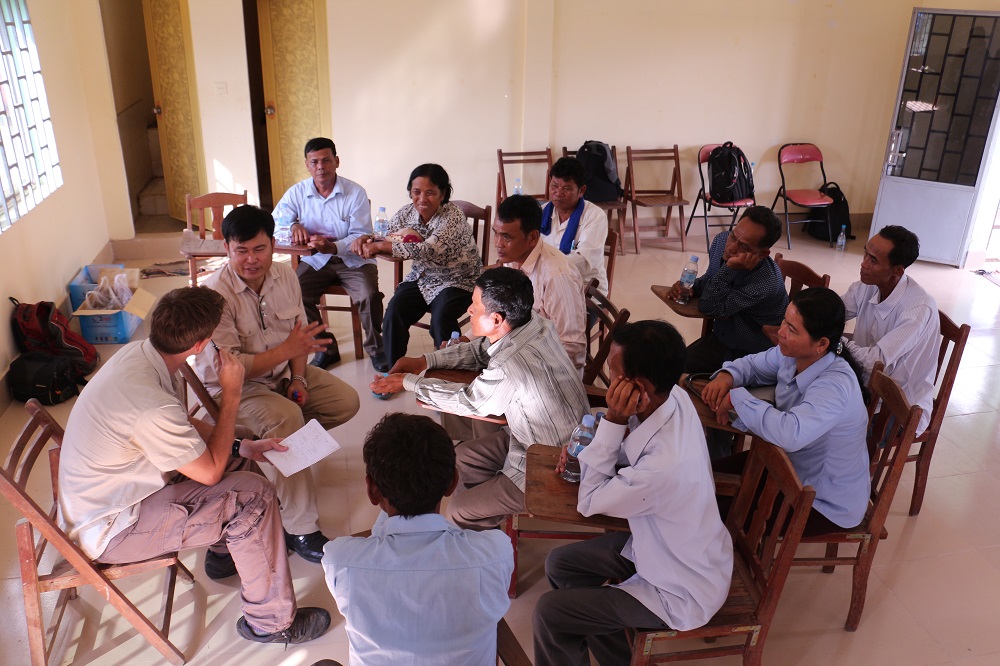
In October 2016, IRRI scientists Jhoana Opeña, Virender Kumar, Alex Stuart, Rica Flor, and Dr. Hadi visited target Cambodian provinces with CARDI and GDA partners to meet with collaborating rice farmers. The team from IRRI presented the results to the farmers and helped them prioritize their pest, weed, and disease problems.
“We sprayed too much pesticide because we don’t know what works,” a farmer summarized his pest and disease predicament. “We need a better way.”
“It was a perfect segue to bring ecologically-based IPM methods into our conversation,” Dr. Hadi said. “Our team and the farmers spent time designing and contextualizing various methods to be tested at the Provincial Department of Agriculture’s (PDA) experimental stations and at farmers’ fields.”
The methods included best-bet agronomic practices to reduce weed infestation, conservation, and augmentation of biological control agents, improvement of farmers’ knowledge on the role of natural enemies of pests in rice ecosystem, and community-based rodent management. The use of pesticides will be limited to situations where other options are not available and optimized for the highest impact. A workshop in Phnom Penh with all national and provincial institutions solidified the research plan for the next rice-cropping season in Cambodia.
“This is only the beginning,” emphasized Dr. Hadi. “Through this partnership, we plan to conduct a series of iterative on-farm research to further tailor the different eIPM components to the local conditions.”
The participation of farmers and local institutions is crucial in these adaptive research cycles. Concurrently, a series of provincial and national learning alliances will be conducted to nurture the institutional environment that is conducive toward large-scale adoption of the eIPM package. Toward the end of the cycles, the validated rice eIPM package will be disseminated in collaboration with the Cambodian National IPM program and other channels. IRRI will also work on needed policy interventions for the successful country-wide adoption of rice IPM.
“The widespread adoption of the validated rice eIPM package is expected to yield a double harvest: curbing both the yield loss due to pests and diseases and the negative effects of pesticide abuse,” said Dr. Hadi.